

Unity. Light. Love.
Solar Activity
Forecast


On this page, you can find out about geomagnetic activity. The forecast covers several days ahead, since solar activity can be predicted only with a degree of uncertainty, even using sophisticated scientific instruments. Nevertheless, these data will help you stay informed to some extent about solar activity during the day and plan your activities in accordance with the graph.
You can also use the solar activity graph to find out how active the Sun was at the time of your birth.
If you were born in a month of an active Sun, you are more resistant to the influence of magnetic storms than people born in a month of a quiet Sun. You can find the solar activity from the solar activity graph.
The link below takes you to a page of live solar activity and space weather graphs. All data are updated every few minutes, so you can have the latest information on today's space weather: 23 November, Monday. Following the link will display an enlarged live image of the Sun, shown below, and other useful solar activity graphs, such as current geomagnetic conditions. Below is an image of the Sun taken a few minutes ago (if you wish, you can enlarge).
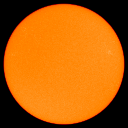
Click to view live graphs and images of the Sun
Click to view a large image of the Sun, taken today (23 November, Monday).
Using the solar activity table, you can determine how active the Sun was at the time of your birth: Solar activity graph.
Below, I would like to give you recommendations on how best to behave on days of geomagnetic storms, during solar activity. These simple actions can minimise the strain on your body and spare you entirely unnecessary risks.
 Exclude alcohol and alcoholic drinks from your diet. Blood cholesterol levels rise on days of magnetic storms. Try not to eat fatty or sweet foods.
The apparent magnitude outside the atmosphere is −26m,78.
The average distance to the Earth is one astronomical unit (AU), or 149,598,500 km. The Sun's diameter is 1,390,000 km, 109 times the Earth's diameter.
The angular size of the Sun averages 32′.
The temperature at the Sun's centre reaches fifteen million degrees.
In the Sun's core, hydrogen is converted into helium, releasing an enormous amount of energy.
The Sun sends streams of charged particles of matter, corpuscular radiation, and radio emissions into space.
The solar atmosphere consists of three layers:
The photosphere is the main part of the solar atmosphere in which visible radiation with a continuous spectrum is produced. In the chromosphere and corona, the density of matter decreases rapidly with height, leaving the outer layers of the solar atmosphere highly rarefied. Therefore, even at a very high temperature of about a million degrees, the radiation from these layers is relatively small. See also Planets of the Solar System.
Return to the section: Astrology.


