


An original article · Your Yoga
Who Is the Swan Princess? The Hidden Spiritual Meaning of Pushkin's Fairy Tale
Reflections on cosmic energy, illusion, freedom of choice and the extraordinary possibilities of human life.
Sergey Veretennikov (Om Shanti)
Contents
- The Island Where Life Begins
- A Person’s First Choice: To Survive or to Live?
- Who Is the Kite?
- Why Could the Powerful Swan Not Defeat the Kite?
- The Sacrifice That Opened the Universe
- The Swan’s Most Mysterious Words
- Why Do I Consider the Swan a Cosmic Power?
- Why Does She Ask for Nothing in Return?
- Why Does the Swan Become Gvidon’s Wife?
- Freedom of Choice — the Central Law of This Story
- From Survival to Truly Living
- The Main Idea
Recently, I decided to listen carefully once more to Alexander Pushkin’s "The Tale of Tsar Saltan". Not simply as a literary work familiar since childhood, but as a possible ancient spiritual message in which the fairy-tale imagery conceals profound knowledge about human beings, their birth, life and relationship with the Universe.
The more attentively I listened to the tale, the more astonishing parallels I discovered.
Of course, I am not claiming that this is precisely the meaning consciously intended by Pushkin or by the ancient storytellers from whom he inherited the plot. This is my personal esoteric reading. Some of the parallels may be coincidental. But some are so interesting that I wanted to share them with you.
Today I want to focus on one of the tale’s most mysterious heroines: the Swan Princess.
Who is she? Why does she possess incredible power? Why can she create entire cities almost instantly, grant wishes and command wondrous beings, yet find herself helpless before what appears to be an ordinary kite?
And most importantly, why does she reveal her powers specifically to Gvidon?
I feel that the answers to these questions could change our understanding not only of the fairy tale, but also of our own lives.
The Island Where Life Begins
First, let us recall how Gvidon came to be on the island.
His mother, the young tsarina, was treacherously imprisoned in a barrel with her son and cast into the ocean.
I have previously considered the possibility that this episode symbolises the development of a human embryo in the mother’s womb.
In that reading, the barrel becomes an image of the womb: an enclosed space in which new life develops. The ocean symbolises the primal waters of life, including the amniotic environment surrounding the embryo.
In Pushkin’s tale, the child grows extraordinarily quickly. At a certain point, he himself asks the wave to carry them ashore.
This recalls the moment of birth, when the fully developed foetus, together with the mother’s body, participates in the complex process of coming into the world.
Gvidon emerges from the barrel with his mother.
If we continue this analogy, his mother symbolises Shakti: the maternal life energy that accompanies a person into incarnation.
And I suggest that we see the island they reach as the person’s own life.
Consider how remarkable this image is.
Gvidon finds himself on an almost empty island. There is no palace, no wealth, no beautiful city. There is not even any certainty that he will be able to eat tomorrow.
This is precisely how human life begins.
When a child is born, their entire destiny still lies ahead. They do not know what their life will be like, whom they will meet, what they will create, or what abilities they will discover within themselves.
For them, the island of life is still empty.
Yet we, the readers of the tale, already know that in the future the island will have a magnificent city, a magical squirrel with golden nuts and emerald kernels, and thirty-three mighty warriors, while Gvidon himself will find love, a kingdom and wealth.
It turns out that all this is already contained within his island’s possible future. But Gvidon himself knows nothing of it yet.
And here the most interesting part begins.
A Person’s First Choice: To Survive or to Live?
Gvidon has only just arrived on the island.
He is hungry. His mother needs food too.
The young prince makes an entirely natural decision: to go hunting.
He makes a bow from an oak branch, fits a bowstring, fashions an arrow and goes in search of game.
In other words, he chooses a path familiar to almost everyone: to live, you must obtain food for yourself.
You must work, hunt and struggle to survive.
In a broader sense, you must earn money, meet the needs of the body and provide yourself with everything necessary.
This is exactly how enormous numbers of people live today.
Every morning they wake up and go to work. They earn money to buy food, pay for housing and acquire the things they need.
And so day follows day, year follows year.
Gradually, a person becomes accustomed to the idea that life is an endless struggle for survival.
Yet surviving and living are entirely different things.
You can spend your whole life providing for your existence without ever touching life’s true riches.
It is at this very moment that Gvidon encounters an unexpected situation.
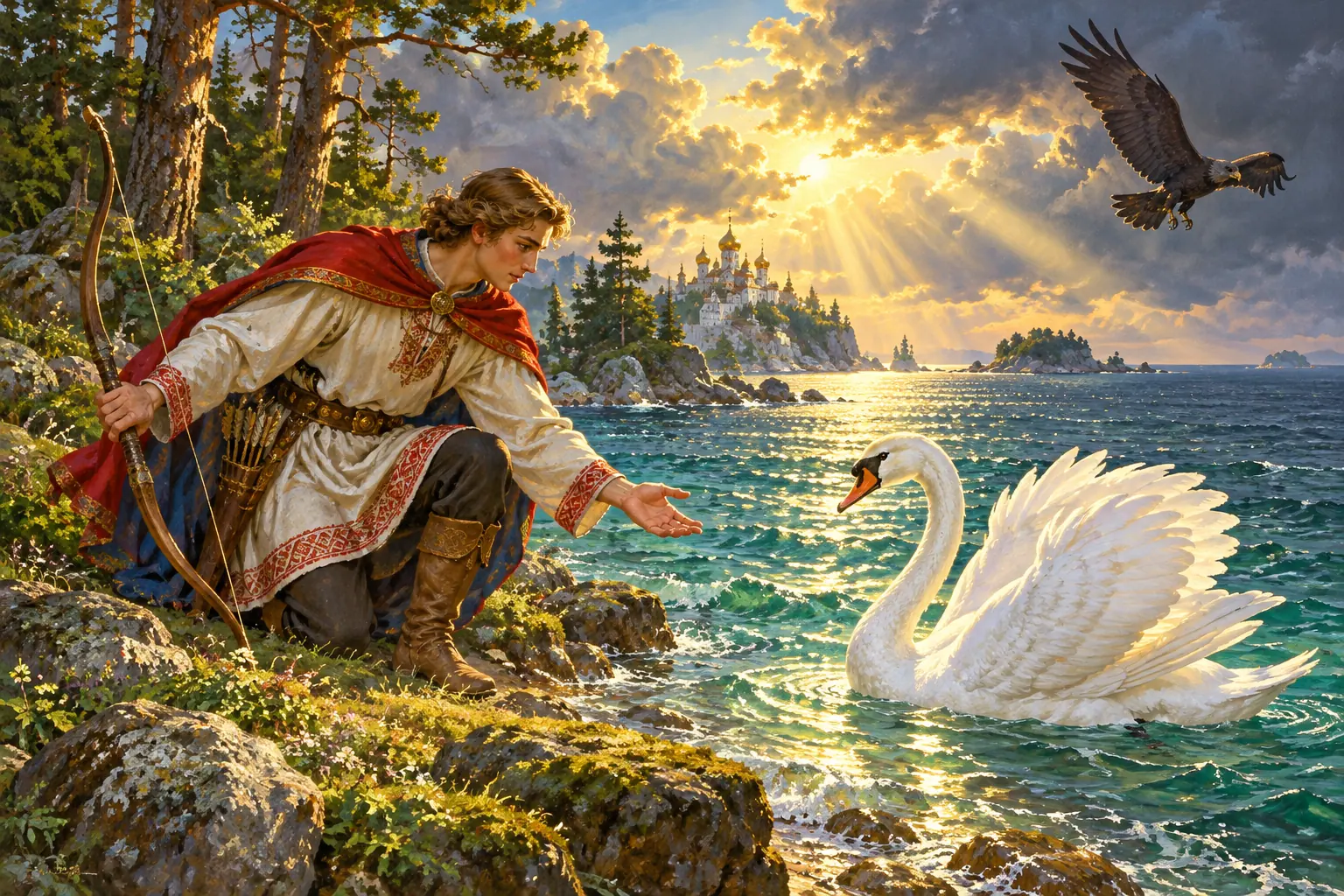
He comes to the sea in search of prey and sees a kite attacking a white Swan.
She is desperately trying to escape, struggling in the water, while the predator prepares to strike the fatal blow.
Gvidon faces a choice.
He can walk past, save his arrow and continue hunting.
After all, he is hungry. His mother needs food too.
Moreover, he has no obligation towards this unfamiliar bird.
He has never even seen her before.
But Gvidon acts differently.
He aims his only arrow not at game, but to save the Swan.
And this action, I feel, determines his entire subsequent destiny.
Who Is the Kite?
Notice that in the tale, the kite turns out not to be an ordinary bird of prey.
After its death, the Swan reveals to Gvidon the true nature of his opponent:
"It was no kite you slew,
But a sorcerer you shot."
It turns out that beneath the bird’s appearance was a magical being capable of taking another form.
Here, the concept of Maya from Vedic philosophy comes to mind.
Maya is the cosmic power through which the manifested world is perceived in a particular way. In spiritual teachings, special importance is attached to its ability to conceal the true nature of reality.
For example, the sun continues shining even when clouds cover it.
But a person beneath those clouds can no longer see the sunlight.
The sun has not disappeared. What has disappeared is the ability to perceive it directly.
Spiritual ignorance — avidya — works in a similar way.
A person lives in an immense Universe filled with possibilities unknown to them, yet perceives only a small part of reality.
They see the material world, their needs, desires, fears and problems.
But the deeper nature of existence remains hidden from them.
I suggest that the sorcerer-kite symbolises this very veil of illusion.
He prevents Gvidon from meeting the Swan.
Had the prince not intervened, he might never have discovered the extraordinary power that later transformed his entire life.
There is another image here too.
The white Swan in the water and the kite attacking from above remind me of a confrontation between two opposing principles — almost like the symbol of Yin and Yang in Chinese philosophy.
Of course, this is not an exact representation of the Chinese symbol: Yin and Yang are not simply good and evil. Yet the image of two interacting forces, one bright and the other threatening, evokes that association.
What matters here, however, is less the birds’ confrontation than Gvidon’s own attitude towards them.
He chooses which of these forces will shape his future life.
Why Could the Powerful Swan Not Defeat the Kite?
This is perhaps one of the tale’s central mysteries.
Later, we discover that the Swan possesses truly incredible powers.
She can create cities, change a person’s appearance, grant wishes and command wondrous beings.
And yet some sorcerer almost destroyed her!
Why could she not deal with him herself?
I think the reason may be that this scene is not telling us about the Swan’s weakness at all.
It is telling us about Gvidon’s freedom of choice.
Suppose the Swan symbolises cosmic energy, the universal life force that permeates everything in existence.
In the yogic tradition, we find a similar concept: prana. In Chinese philosophy, qi.
I am not claiming that these concepts are entirely identical, but all of them are, in a certain sense, connected with the idea of life energy.
This energy is present everywhere.
It does not need a person to create it.
But people can be open to interacting with it to different degrees.
The kite, then, symbolises not so much a force capable of destroying the Universe itself as a force capable of cutting a person off from direct contact with it.
The Swan cannot make Gvidon’s choice for him.
She may possess immense power, but she does not impose her help on him.
Gvidon must free himself from the illusion that separates him from this power.
And he does so in a very unusual way.
The Sacrifice That Opened the Universe
Here I want to draw attention to something extraordinarily important.
Gvidon did not know whom he was saving.
Before him was neither a radiant princess, nor a beautiful goddess, nor a powerful being promising to grant all his wishes.
Before him was what he took to be an ordinary, helpless bird.
And this bird promised him nothing.
She offered no wealth, power, love or immortality.
Gvidon simply saw a living being in need of help and decided to save it.
Moreover, he had to sacrifice something quite substantial.
His arrow, intended to obtain food, disappeared into the sea.
The Swan later tells him directly that, because he saved her, he may go without food for three days.
Pushkin himself tells us that Gvidon and his mother went to bed hungry that evening.
In other words, the sacrifice was real.
This was not a choice between a sweet and an ice cream.
Gvidon sacrificed the opportunity to meet a vital need.
But for what?
For a complete stranger from whom he expected nothing.
That is true selflessness.
This is why I feel it is fundamentally important that the Swan did not first appear before him in her beautiful human form.
Imagine if Gvidon had immediately seen a radiant princess capable of performing miracles.
Would he not have wanted to help her?
Perhaps he would.
But then we could no longer confidently speak of selflessness.
He might have been saving her for the sake of beauty, love, wealth, a future kingdom or extraordinary powers.
That would have been calculation.
But in the actual story, there is no such calculation.
Gvidon helps not because he hopes to receive something. He helps because he can respond to another’s distress.
And it is after this that an entirely different world opens before him.
The Swan’s Most Mysterious Words
Once rescued, the Swan speaks words to which I attach special importance:
"I shall never forget you:
You will find me everywhere."
Consider their meaning.
The Swan promises more than simply to remember her rescuer.
She says that Gvidon will be able to find her everywhere.
Not in a particular palace. Not in a forest. Not on some distant island.
Everywhere!
If we see the Swan as a symbol of universal cosmic energy, these words become especially expressive.
Prana does not exist in just one place.
Life energy is not confined to the walls of a temple or to a place of spiritual practice.
Within this spiritual understanding, it is present throughout nature and throughout the space around us.
And a person does not have to travel to the ends of the earth to seek it.
It is already here.
In existence itself.
In their own life.
Yet an important distinction arises here: being surrounded by energy and consciously interacting with it are not the same thing.
I suggest that Gvidon’s action symbolises precisely this transition.
He does not create the cosmic power.
He does not conquer it.
He does not force it to serve him.
He performs a selfless act — and discovers that the Universe can respond to him.
Most astonishingly, this power promises him not short-lived assistance, but constant availability.
The Swan sets no expiry date on her promise.
This is neither a one-month contract nor a service for a set fee.
She promises to remember him always.
Symbolically, this can be understood as the establishment of a lasting bond between a person and the higher life force.
Why Do I Consider the Swan a Cosmic Power?
Let us look at what we actually know about the Swan Princess.
We shall begin with her origins.
The tale tells us about Gvidon’s family in detail. We know his mother, father, aunts and grandmother. The whole story is built around family relationships.
Yet we are told almost nothing about the Swan’s own parents.
Who is her father? Her mother? Where did she come from?
No one even asks such questions.
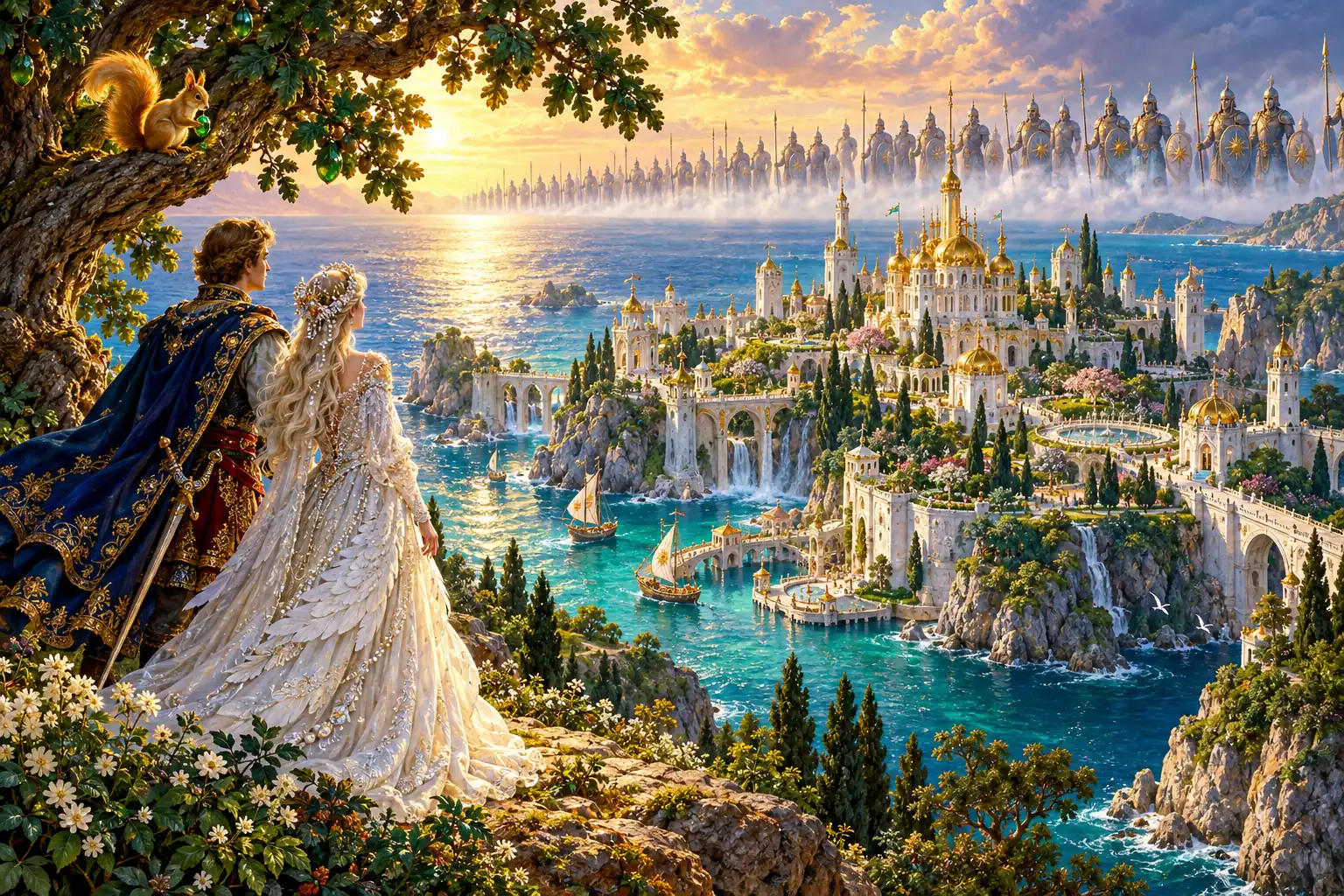
Yet we learn that the thirty-three extraordinary warriors of the sea are her own brothers.
Led by their elder, Chernomor, these warriors emerge from the sea’s depths in scale armour gleaming like fire.
They appear every day, guard Gvidon’s city, and return to the sea because the air on land is oppressive to them.
And all of them obey the Swan’s command.
Just imagine the power of a being whose own brothers are thirty-three legendary warriors, ready to come at her request and guard an entire kingdom!
But that is not all.
The Swan has the power literally to transform Gvidon’s reality.
After their first meeting, he wakes to find a magnificent city where the deserted island had been.
Later, thanks to her, an extraordinary squirrel appears, cracking golden nuts with emerald kernels.
Then the thirty-three warriors arrive.
She helps Gvidon take the form of small insects, enabling him to travel to the kingdom of his father, Saltan.
And she does all this with astonishing ease.
To Gvidon, these events are incredible miracles.
To the Swan herself, they seem a natural expression of her powers.
What seems miraculous to a person may be an ordinary expression of the Universe’s nature.
There is another astonishing detail.
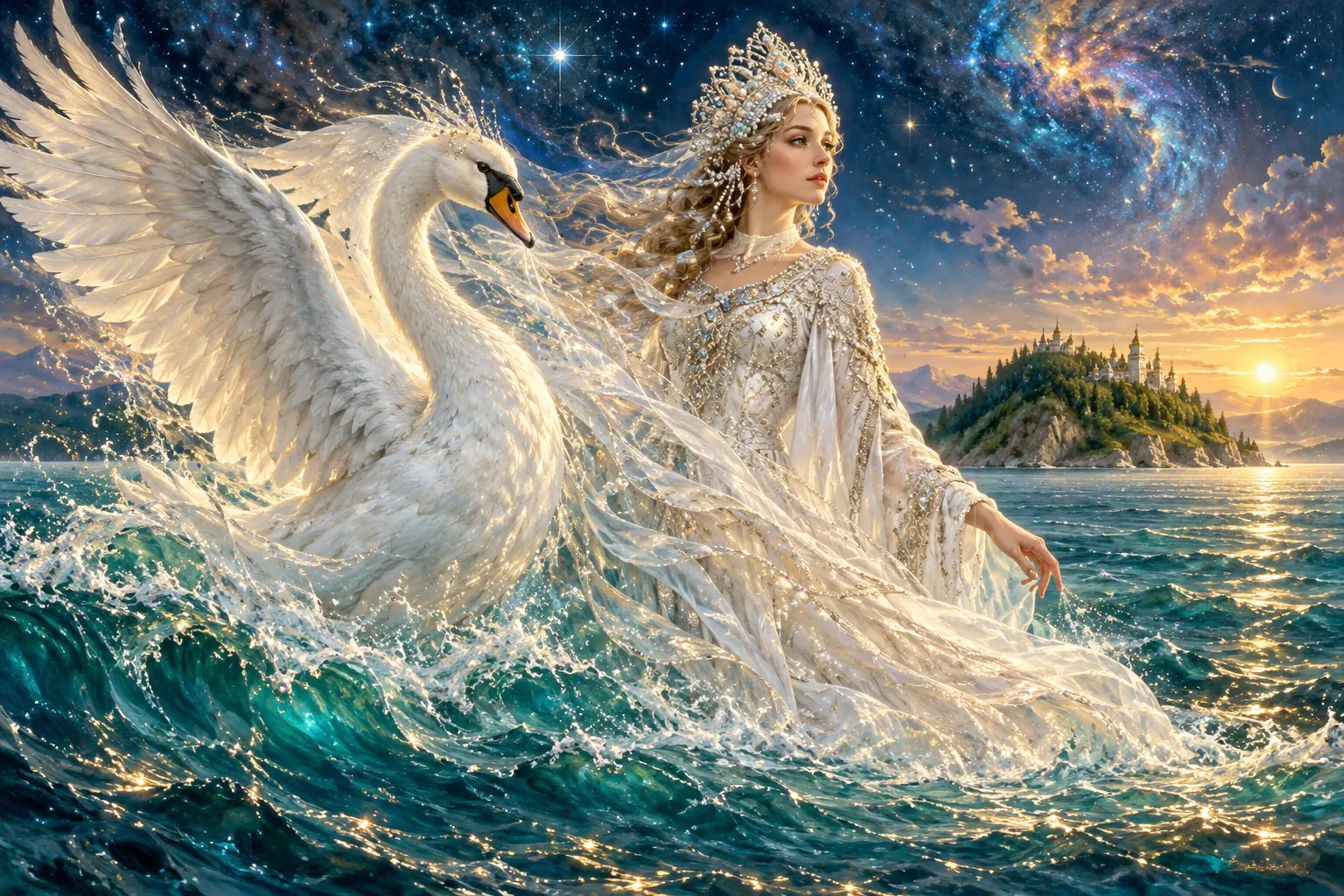
When the Swan reveals her true form as a beautiful princess, a star burns upon her forehead and a crescent moon shines beneath her braid.
The tale even says that by day her radiance eclipses the daylight, while at night she illuminates the earth.
This is no longer merely the description of a beautiful woman.
It is the image of a being who unites the heavenly lights, the light of day and of night.
Earlier, I suggested that in a spiritual reading, Saltan might symbolise the solar principle.
But the Swan Princess seems to reach beyond a single celestial body.
Her image encompasses a much greater expanse.
That is why I suggest that the Swan may symbolise not a particular force of nature, but universal cosmic energy connected with the whole Universe.
Why Does She Ask for Nothing in Return?
I want to draw attention to another point.
When the Swan begins helping Gvidon, she does not impose complicated conditions.
She does not demand years of service.
She does not make him perform special rituals.
She does not ask him to worship her.
She simply helps.
Moreover, her help far exceeds Gvidon’s initial sacrifice.
He sacrificed one arrow and the chance to have supper.
And he received an entire kingdom.
Are these things remotely comparable?
Here I see a symbolic contrast between two entirely different ways of living.
The first is the path of survival.
A person is constantly calculating how much money they must earn, how much effort they must make and how much time they must spend to obtain what they want.
The second is the path of interacting with a higher power.
Here, a person ceases to see their own physical efforts as the sole source of every possibility.
They open themselves to life, learn to trust, act selflessly, and notice help that may arrive in unexpected ways.
Of course, I am not suggesting a literal reading of the tale, as though saving a bird once would produce a free palace the following morning.
We are speaking of a spiritual principle, not a guaranteed means of material enrichment.
A person may be so occupied with the struggle for survival that they cease to notice the opportunities directly before them.
Perhaps some of these opportunities become available only when a person stops being guided exclusively by personal gain.
Why Does the Swan Become Gvidon’s Wife?
This is another important part of the tale.
At first, the Swan acts as an external helper.
Gvidon comes to the sea, tells her his wishes and receives help.
But then something astonishing happens.
He learns of a princess of extraordinary beauty and wishes to marry her.
The Swan reveals that she herself is that princess.
All this time, then, Gvidon has been seeking happiness and love without realising that they were already beside him.
He dreamed of a distant miracle, although the miracle was already present in his life.
Continuing my interpretation, this scene may symbolise a new stage in a person’s relationship with cosmic power.
At first, they perceive it as something separate.
It helps them from outside.
Gradually, however, the person begins to realise that this energy is not alien to their own nature.
It is present within them too.
Gvidon’s union with the Swan Princess becomes a symbol of a deeper unity between individual consciousness and the universal principle of life.
It matters here that the Swan becomes his wife only after Gvidon himself makes this choice.
She does not impose herself on him.
She even advises him to think seriously about his decision to marry.
Once again, the theme of free will emerges.
Their union takes place by mutual consent, not compulsion.
Freedom of Choice — the Central Law of This Story
I feel that freedom of choice is precisely what binds all these events into a single whole.
When Gvidon first appears on the island, he has practically nothing.
Yet two possibilities are already open to him.
He can continue hunting and concern himself exclusively with satisfying his own needs.
Or he can help an unfamiliar being, sacrificing what he has.
He chooses the second.
Only afterwards does he discover the power he has set free.
Here I see a very profound spiritual idea.
Suppose the Universe really is filled with an intelligent life force capable of interacting with human beings.
Yet the principle of freedom of choice also exists.
A higher power must not force a person to follow a particular path.
It may be present beside them, but it is not obliged to reveal all its possibilities to someone who does not wish to interact with it.
Much, then, depends on the person themselves.
On their intentions.
On what guides their actions.
On whether they can forgo immediate gain for something greater.
On whether they can show love and compassion without expecting a reward.
For that is exactly what Gvidon did.
And I feel that in this tale he demonstrated not so much courage or physical strength as spiritual maturity.
He still knows nothing of his island’s wonders.
Yet he already knows how to make a choice worthy of a true human being.
After that, life itself seems to begin opening up to him.
From Survival to Truly Living
Looking at the story as a whole reveals a remarkable sequence.
First, Gvidon is born.
Then he finds himself on a deserted island, symbolising the life he has yet to live.
He feels hungry and prepares to obtain food.
In other words, he begins his journey with the natural desire to survive.
Almost immediately, however, he is offered the opportunity to make another choice.
He sacrifices the satisfaction of his own needs to save a helpless being.
He defeats the sorcerer, whom I connect symbolically with the illusory power of Maya.
After this, he gains access to the Swan Princess: an extraordinary, omnipresent power that begins transforming his entire life.
The deserted island becomes a flourishing kingdom.
Riches and wonders appear.
Protectors arrive.
Gvidon gains the ability to travel, to see his father, and then finds love.
Finally, his family is reunited.
Notice that Gvidon does not lose material blessings through his selflessness. On the contrary, he receives far more than he had intended to obtain on his own.
But he did not know this in advance.
And that is precisely what makes his original choice so valuable.
He first showed love, and only afterwards received a reward.
Not the other way round.
I feel that this contains one of the most important spiritual lessons.
People often try to obtain what they want first, promising only afterwards to become happy, kind, generous and grateful.
Once I have earned plenty of money, I will start helping others.
Once I have solved all my problems, I will begin developing spiritually.
Once I have provided myself with everything I need, I will be able to live fully.
But Gvidon did the opposite.
He acted selflessly when he himself needed help.
And that became the beginning of his life’s transformation.
Perhaps the tale’s spiritual meaning is that a person does not first have to become rich, strong and powerful to begin living in harmony with the higher laws of existence.
It is enough to make the right choice one day.
Not for a reward.
Not for miracles.
Not for future gain.
But because the heart says: this is what should be done.
And then, perhaps, the person will discover that the world is far richer and more astonishing than they had imagined.
The Main Idea
For me, the Swan Princess is a possible symbol of universal cosmic energy, present everywhere, yet never imposing its possibilities on a person.
The sorcerer-kite is an image of the illusion that conceals this power from us.
The island is human life, filled with possibilities not yet manifested.
And Gvidon is the human being facing a choice: to devote life to endlessly satisfying material needs, or to open the heart to something higher.
Here I want to emphasise one thought.
Gvidon did not save the Swan because she was powerful. She revealed her power to him because he saved her selflessly.
Perhaps this is one of the most beautiful spiritual messages of the tale.
We do not have to seek the Universe somewhere far away.
We do not have to travel to far-off lands in search of miracles.
Perhaps what we seek is already close by.
But first we must learn to see something greater than our own needs.
Then one day we may discover that our deserted island is not so empty after all.
Beautiful palaces, countless treasures and extraordinary possibilities already lie hidden within it.
They are simply waiting for their time to appear.
And the greatest treasure may turn out to be neither wealth, nor power, nor the fulfilment of wishes.
It may be the connection itself with that great power through which life exists.
Sometimes a single arrow, released for someone other than oneself, changes a person’s entire destiny.
With love to all who seek Truth, and to those who intend to begin in the near or distant future,
Sergey Veretennikov
OM Shanti 🙏
The Beginning of the "Tale of Tsar Saltan" Discussion at the School
30 October 2026 · Copyright


