Strengthening the Muscles and Tendons
At this level, I want to tell you how to strengthen your physical body considerably, and your energy bodies along with it, since everything is interconnected.
Through this practice, you can increase your physical capabilities as much as you wish.
You will need just one "tool" for the practice, which can easily fit into your pocket and be used anywhere,
wherever you may find yourself (on a business trip or at a holiday resort, for example). This is very convenient, costs nothing (there is no need to spend money on sports equipment or gym memberships) and requires very little time for practice (firstly, because you do not need to spend time travelling to a gym, and secondly, because the nature of the exercises themselves means that a thorough workout of the body's muscles does not take long).
Below, you can see a loop of fabric used for this practice.
You can make it in any way that suits you, even simply taking a strip of sturdy fabric and tying its ends together in a knot to form a loop.
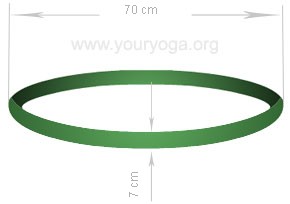
The simplest way to make this loop is as follows: take a piece of fabric approximately 142 cm long (including 2 cm for the seam) and 16 cm wide (including 2 cm for the seam).
Fold it lengthways and stitch along the edges to make something like a sleeve. Turn the sleeve inside out so that the seam is on the inside, then stitch its ends together to form a loop. That is all: your tool is ready.
If you do not want to sew anything, there is no need to: simply take some fabric, fold it over several times and tie the ends together.
Below, I shall give you a series of basic exercises, but your practice need not be limited to these alone.
You can vary them slightly, performing them at different angles to work particular muscles more thoroughly.
In other words, expand your practice if you have the time and desire to do so.
In the first exercise, I shall describe everything in greater detail: how it works and the underlying principle.
For the subsequent exercises, I shall simply give the starting position and the direction of the effort.
Before working through the set below, perform the physical exercises I have described here. For brevity, I shall refer to the fabric loop described above simply as the "loop" in the exercises.
Description of the Sequence
Exercise 1
- Raise your arms. Bend them at the elbows.
Your elbows point out to the sides.
Clench your hands into fists. Your fists are at head height. The loop is around your wrists (in other words, your hands do not take part; your arms are like two sticks with the loop around them). The loop stays in place only because you draw your arms slightly apart in opposite directions. This is the starting position.
- Now tense your arms as though you want to tear the loop apart (it is behind your head). In other words, make an effort to break the loop.
Of course, this will not happen, but that is exactly what you try to do.
- Make the first effort gentle to avoid injuring your muscles.
Maintain the tension for 3–5 seconds.
- Then lower your arms and rest for approximately 10–30 seconds.
- Return to the starting position and once again try to "tear" the loop apart for 3–10 seconds, now with greater tension.
- Rest again, then repeat the exercise at maximum intensity: apply your greatest strength to "tear" the loop apart, for 3–15 seconds.
- Continue breathing while you maintain the tension.
Your breathing must continue; do not hold your breath throughout the entire effort.
Naturally, your breathing will be restricted and strained, but you must keep breathing (like someone holding a sack of cement, for example: they are under considerable strain, but cannot hold their breath for long, so they combine exertion with breathing).
- This exercise greatly develops the triceps and the entire group of muscles responsible for pushing with the arms. Those who practise martial arts or boxing will particularly appreciate it.
- As you can see, the exercise excludes the work of the hands, so the maximum targeted load falls on the muscles you are developing.
- You can stand or even walk while performing the exercise. Walking draws your attention away from the tension, making the exercise easier (for example, you can walk around the room while maintaining the tension).
As I have already said, the hands are not used in this practice: you tense the required muscles in isolation. You will even discover a certain comfort in this kind of tension.
In other words, you tense your muscles to the maximum, yet you do not feel particularly tense or as though you are working very hard, as you do when using a barbell or other exercise equipment, for example.
You simply tense individual muscles, as strongly as possible, and feel virtually no fatigue. You expend a minimum of energy on the exercises, while your muscles and tendons develop as powerfully and as quickly as possible.
Take, for example, an ordinary athlete working out in a gym. They use dumbbells, a barbell and other exercise equipment. The muscles of their hands are constantly under excessive strain because all their physical exercises require them to grip a barbell or other weights. What does this mean?
It means that this approach offers no opportunity to work the muscles in isolation and give them the load they need. As a result, some muscles are constantly subjected to extreme overtraining, while others receive too little load. This set of exercises is entirely free of this drawback, as well as others, as you will discover.
Exercise 2
- Lower your arms. Your arms and the loop are behind your back at buttock level (the loop rests against your buttocks). The loop is around your wrists. Your arms are straight or slightly bent.
Clench your hands into fists, with the finger joints facing one another. In other words, the loop rests against the outer sides of your wrists.
- Begin to "tear" the loop apart. The action is similar to holding two dumbbells and trying to raise them.
- A very powerful exercise for the shoulders.
Exercise 3
- This exercise is exactly the same as exercise 2, except that your arms and the loop are in front of you rather than behind you.
Exercise 4
- Raise your arms and bring the loop behind your neck. Hold your arms in front of you, bent at the elbows. The loop rests against the inner sides of your wrists.
- Begin applying tension by trying to straighten your bent arms. It is as though you are pushing against a wall in front of you (or pushing a barbell upwards while lying down).
- The exercise develops the triceps and the muscles at the back of the neck well.
Exercise 5
- This exercise is exactly the same as exercise 4, except that your bent arms push downwards rather than forwards.
Exercise 6
- Raise your arms high above your head. The loop rests against the inner sides of your wrists (in other words, turn your arms so that the inner sides of your wrists face outwards).
- "Tear" the loop apart above your head.
- An excellent exercise for the outer back muscles and the base of the triceps.
Exercise 7
- Raise your arms. Place the centre of the loop against your head, approximately just above your forehead.
- Apply tension by pulling your arms backwards (as though you were pushing open a huge pair of gates).
- The exercise develops the inner back muscles, the triceps and the muscles at the front of the neck.
Exercise 8
- Raise your arms. Place the centre of the loop on the crown of your head.
- Apply tension by pulling your arms downwards.
- The exercise develops the middle back muscles, the triceps and the muscles at the sides of the neck.
Exercise 9
- Double the loop over. Put your hands through it. The loop and your hands are in front of your chest.
Grip the loop with your hands and try to "tear" it apart by drawing your arms out to the sides (the classic horseshoe-breaking action).
- Develops the upper back muscles.
Exercise 10
- Bring the loop behind your buttocks (and underneath them, as though you were sitting on it). Your arms are bent at the elbows in front of you.
- Apply effort by trying to bend your arms further. The action is similar to performing a biceps curl with a barbell.
- The exercise develops the biceps.
Exercise 11
- Bend forwards and lower your arms. Stand on the centre of the loop with both feet.
- Put your hands through the loop and grip it.
- Your legs are slightly bent.
- Pull your hands towards you, trying to "tear" the loop apart.
- The exercise develops the forearm muscles, the rear shoulder muscles and the lower back muscles.
Exercise 12
- Sit on the floor. Bend your legs and put the loop around them from the knee end (in other words, slip it over your knees and push it well down).
- Lean your torso back slightly and support yourself on your elbows.
- Try to straighten your legs (the loop, positioned around the lower shins and the base of the thighs, will resist this).
- An excellent exercise for developing the leg extensor muscles.
Exercise 13
- Stand up. Place the loop around your shins, with your feet wider than shoulder-width apart.
- Try to spread your legs still wider, "tearing" the loop apart with your legs.
- The exercise develops the outer leg muscles.
Exercise 14
- Fold the loop over several times.
- Raise your arms to chest height. Clench your hands into fists. Bring your fists together, with the repeatedly folded loop between them.
- Begin applying tension as though you want to compress the loop in front of your chest as much as possible.
- The exercise develops the chest muscles.
Notes
- Be careful if you devoted little time to your physical development before starting this set of exercises.
Do not use your maximum strength to "tear" the loop apart.
The hands are bypassed in this work. In ordinary physical exercises (with dumbbells, for example), they greatly limit the load you can place on the required muscle groups, so accustom your muscles to the load gradually and do not tense them too strongly at first.
- Remember that I have given all the necessary explanations only in the first exercise. They are not repeated afterwards, to avoid making the description of the practice too "heavy".
I have also tried to avoid medical terminology when naming muscles, using terms such as "front muscles", "rear muscles" and so on instead.
- Unlike exercises with barbells, dumbbells and so on, most of which "give" you fatigue and exhaustion, this set gives you a surge of strength immediately after completing it. In this respect, it is somewhat like Yoga asanas.
You do not expend energy; on the contrary, you accumulate it. At the same time, your muscles are increasingly trained to accumulate more and more energy.
- When you first begin working with this set of exercises (during the first week, for example), you may experience slight discomfort in your muscles and tendons.
This is normal, as the muscles are adapting to the loads.
All these sensations will soon pass with regular practice.
- Although all the exercises in this set appear to be physical, they are actually more than physical exercises alone.
They also develop your energy, strength of spirit and more.
© Sergey Veretennikov
28 February 2010
Go to BOE-do
Information




