

Unity. Light. Love.
Practice
Numerological Mudras
(The Teaching of Digits)


A few days have passed since I gave you the treatise on digits. Some of you have already reflected deeply on this information, some have even meditated on it, and others have at least given it some thought.
First, I want to answer a question I have been asked about digits. My answer is this: 0 is a digit, and counting begins with it, not with one (1). Ten, however, is a number, not a digit. More precisely, it is the number of all the digits, of which there are ten, including zero, of course. In giving this answer, I have not consulted any mathematics textbooks or similar sources. What matters to me is giving you the original understanding of digits, rather than their interpretation. I hope you now clearly understand that 0 is the first digit, while 10 is a number: the number of all the digits.
For clarity, look at the drawing below, where I have numbered every finger to eliminate any possible misunderstanding.
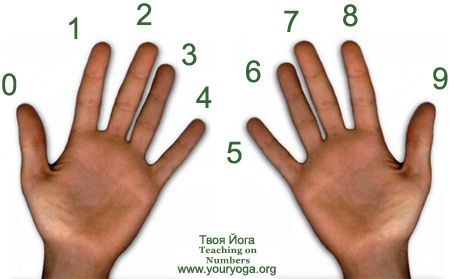
As you can see, there is a very interesting fact: the left thumb is zero, while the right thumb is nine. These are the two extremes, one at the beginning and the other at the end.
You can now understand which mudra the Buddha held before attaining Enlightenment. Look at the image below, showing the Buddha in the position most commonly used to depict the moment of his Enlightenment: the thumbs are joined and the right hand rests on the left.

This is not artistic or religious symbolism; the Buddha really did hold this mudra. Through the teaching of digits I am giving you, you can now understand why and for what purpose. This mudra signifies 09, or 9. It represents the process of ending the cycle of samsara and stepping out of it. You no longer go round the circle of 1, 2, 3 and so on: you leave it. Another striking point is the shape of 9. Look closely. What do you see? A 0 at the top and a curl below, indicating a way out of circular motion, the wheel of samsara. Its opposite is 6, symbolising entry into that circle.
The left hand signifies life in the material world; the right, life in the spiritual world. The five fingers of the left hand represent the five material senses through which material life is created. The pattern of lines on the left hand is a map of life in the manifested, material world. The five fingers of the right hand represent the five spiritual senses through which spiritual life is created. The lines on the right hand map your spiritual life. Left and right are Yin and Yang, feminine and masculine, material and spiritual, manifesting life and giving life, macrocosm and microcosm. The right hand rests on the left because spirituality is higher, because Spirit descends into Matter, because the masculine is active and the feminine passive.
You can now understand even more clearly that the hands you see every day are much more than parts of your body. They contain profound information and are a wonderful practical tool for development. We can and should use all this. It is knowledge that will inevitably help us.
Use this mudra whenever you can. You need not hold it only while seated in meditation. I can recommend holding it when going to sleep, for example. Once in bed, place your hands in this mudra on your abdomen, somewhere below the navel. Lie relaxed on your back, with the hands forming the mudra, the wrists following the curve of your waist and the elbows resting on the bed at your sides. The position is stable, so you will continue holding the mudra even after falling asleep. Many people will eventually turn onto their sides, of course, but all of you will hold it for a while: half an hour, an hour, and so on. The important thing is that you can do this effortlessly, even if you cannot find time for it during the day.
I also want to tell you about another very familiar mudra: gyana mudra, in which the thumb and index finger touch to form a ring while the other fingers remain straight.
Let me say immediately that this mudra should be held with the left hand only. The two fingers touching are those numbered 0 and 1, which exist only on the left hand. Incidentally, early depictions of the Buddha show him precisely this way, not holding gyana mudra with both hands, or with the right instead of the left. He holds it with one hand, the left, usually resting on the knee or near the chest. The right hand is completely open and rests below the navel or on the knee. How is this explained? Zero belongs only to the left hand, to the material world; it is zero, matter, that provides development1. Thus 0 brings development to 1, 2, 3 and 4, giving rise to gyana and the other mudras. Everything belonging to the spiritual world, the right hand, needs no development: it is inherently perfect, by virtue of its perfection beyond time and space. Having developed in matter, the individual moves through the spiritual world, through the next digits beginning with 5, carrying accumulated experience, spiritualising it and reaching nine (see the Enlightenment Mudra), then returning to matter to unite matter and spirit: the number 10. The distinction between material and spiritual is quite relative, because you, as beings of Light, never lose your spiritual existence. Even in matter, you are always spiritual. Every stage to be traversed in the spiritual world can also be traversed during this material life, if you are sufficiently interested and do not waste time on meaningless things.
Now we come to the most interesting part: the number 10. As I said, it is the union of matter and spirit, the left and right hands, and therefore all the digits. Ten is greater than nine, meaning there is something beyond Enlightenment, something greater than the digit nine. That greater thing is the number 10.
Which mudra corresponds to this? Perhaps you have already guessed: the namaste2mudra, or, more familiarly, joining the palms before the chest in prayer. This mudra unites all the digits into the number 10, signifying that the cycle is complete, the path has been travelled and everything is accomplished.
Finally, I want to tell you about another mudra of the number 10. It resembles the Enlightenment Mudra with just one difference: the right hand rests on the left, all the fingers are straight and held together, and no fingertip pad touches another. The Buddha held this mudra after his Enlightenment. It is less well known because it is little understood. Try using it. Ten is the maximum, beyond even Enlightenment.
Practice given on 30 March 2010.
© Author: Sergey Veretennikov (Om Shanti)
___________
1. The Russian word for development, razvitie, can be read as combining raz and vitok, a turn around a circle; likewise, razvit, to develop, combines raz and vit, to wind or twist.
2. Namaste translates as "hello" when meeting and "goodbye" when parting. In the context of this practice, the person holding it might be saying, "Farewell, samsara!"
Below, I will give an example of how you can use everything described above in a somewhat more systematic way.
You do not have to complete every stage of this sequence in one sitting. You could hold mudra 01 for one day, move to mudra 02 the following day, and so on.
Sequence given on 30 March 2010.
© Author: Sergey Veretennikov (Om Shanti)
Q: Have I understood correctly that gyana mudra should be held only with the left hand, while the right hand remains straight?
A: That is more correct.
Q: Please explain why the description of Initiation into BOE-do says to place the left palm on the right during meditation on light, whereas mudra 09 has the right hand on the left?
A: Both are nines. In BOE-do, the mudra comes from zazen. For simplicity, we can distinguish 09/A, left on right, and 09/B, right on left. When the left rests on the right, spirituality within is seeking to know itself: in other words, seeking the Buddha, the nature of Enlightenment, within. It is spirituality directed outwards from matter. In 09/B, the reverse occurs: spirit enlightens matter.
Q: Why does 6 signify entry and 9 signify exit?
A: Take any vessel and fill it with water. You pour the water in from above; six has its entrance at the top. Make a hole in the vessel and the water flows downwards; nine has its exit at the bottom. You even write 6 and 9 this way: for 6, the pencil moves down from the top and then around the circle; for 9, it goes around the circle and then down to the exit. The familiar Tao symbol also contains the forms of 6 and 9. Russian fairy tales — simplified information from an ancestral civilisation, in other words — often refer to nine through a ball of thread that leads someone out of a bad place or towards something important. The ball of thread is a 9: the ball above, the loose end below. Accordingly, 6 is a ball being wound up. None of this is accidental. Digits, like our ancient original alphabet, hold profound meaning on many levels. If you are troubled by nine's exit pointing downwards, when spiritual things are conventionally imagined above, in the heavens, I would add that this is not primarily about up and down. It concerns entering a closed circle and leaving it, moving away from that circle, irrespective of direction. At the same time, one enters the six from a higher world and emerges from it, now as a nine, transformed: development.

Q: I once saw a statue of the Buddha with his thumbs resting on his palms. Is that acceptable, or is it better to form a ring?
A: The thumbs and the other fingers should form a circle, with the left fingers forming the tail of the nine. This creates the necessary flow of energy. You will be able to feel it yourself after sitting this way for a while.
Q: Must I sit with a straight back when holding mudra 9?
A: In this case, it is better to sit with a straight back. Simply sit and feel the current created by the energy. As I said in the practice, you can also do it lying down before sleep, while falling asleep.
Q: I do not understand how far the fingers should extend into the other hand.
A: Approximately like this: the fingertips of the right hand rest against the raised areas at the bases of the left fingers.
Q: While holding namaste mudra, can I think, "Hello, Enlightenment", or "I greet you, Enlightenment"?
A: Of course.
Questions and answers published on 15 April 2010.
© Author: Sergey Veretennikov (Om Shanti)


