

Unity. Light. Love.
Practice
The Himalayas-1 Energy Concentrator


(This structure is intended for contemplation, not treatment. Maintain a free flow of fresh air and ensure that you can leave immediately.)
 Rejuvenation, healing and development are not all that this device can offer.
I began discussing this subject here. I studied it for several years and, as a result, decided to create something of my own.
So I assembled a device at home that I am testing on myself. At present, everything is still at the experimental stage. I decided to give it a name, because it incorporates some of my own ideas, although I certainly wish to pay tribute to Reich, Kozyrev and others. The idea is entirely theirs. At least, I learnt about it through their work and through those who pass that work on. A device needs a name. I decided to call it the Himalayas-1 Energy Concentrator. Why this name? I will explain below.
My main aim: to create a structure that anyone can assemble and use at home, even with little space, and that can fold away behind a cupboard, beneath a bed, on a balcony and so on, becoming unobtrusive and keeping out of the way. At the same time, it should work extremely well and cost next to nothing.
Cost: 2,000 roubles (35 dollars).
Roofing sheets used: flat sheets measuring 1.25 metres by 2 metres, 0.35 mm thick, made of galvanised steel with a slightly reflective surface. In other words, I used familiar roofing sheet metal, the kind used to cover house roofs, available from any builders' merchant, with home delivery if required. For anyone particularly interested, here is a link: here. Four sheets were delivered to my home, rolled up. Bear in mind that this is metal, steel, and if you are not physically strong you will need someone to help carry it.
Diameter of the completed structure: 110 cm.
Height: 125 cm.
Version: for seated meditation. You can sit on a chair if you wish, cross-legged, in the lotus position, on your heels or in any other comfortable way.
The main features combined in this device are: ease of construction, low cost, readily available materials, a structure that can be taken apart and put under the bed out of the way, the work of Reich and Kozyrev, and my own understanding.
So why Himalayas-1? Yogis, Teachers, famous mystics — in short, all those who attained something extraordinary — would withdraw into the mountains. Mountains shield a person from civilisation, cutting off various attachments, channels and everything else that drains energy and strength. The mountains themselves also act as reflectors. This is a well-known fact. I thought: why go to the Himalayas when you can do everything at home? You can have a small space at home equivalent to the Himalayas, enter it and develop rapidly. And development is not all...
I decided to make a short animated film for you, because I know such films are very motivating.
The film does not cover everything. It demonstrates the device visually. On this Your Yoga page, I will also describe several versions of the structure, because I know some people will only be able to make the simplest version, while others will have the resources to build the most elaborate one.
The main version, however, is shown in the video. It is the happy medium.
First I will describe the best version, then work down towards increasingly accessible options. Let me say immediately that even if you can manage only the simplest version, it works in exactly the same way as the best. The only difference is that you need to spend longer inside the simpler version to achieve the same result as in the enhanced one.
Let us begin at the beginning, in case anyone does not know what roofing sheet metal is. It is simply metal used to cover roofs. Some roofs use tiles, some slate or other materials, but recently sheet metal has become a very inexpensive option. Think, for example, of church domes: anyone who has seen them being covered will recognise the similarity. It is not bare metal, however. The metal is usually coated with something for durability. As I said, I used galvanised steel sheets, the most common option. I do not recommend painted sheets; galvanised steel is preferable. Its surface is slightly mirror-like. These are good sheets: they bend easily and produce a neat result. Your sheets may differ slightly, and that is fine. You may find ones that are more or less reflective, slightly wider or slightly thicker. It does not matter. I bought 0.35 mm sheets; you might buy 0.4 mm ones. That is excellent. However, do not choose sheets that are excessively thin.
This is what it looks like:

click to enlarge

click to enlarge
The practical difficulty amounts to little more than this: call a builders' merchant, give them the address for delivery of galvanised steel sheets, and they will deliver them that day. Pay a little extra and they will bring them right into your home.
Be careful with the sheet edges, which have burrs, and with the corners, which are, as you can imagine, sharp. You are working with steel, after all. You can cover them with adhesive tape straight away. Those who wish to be particularly thorough can file them smooth.
The sheets bend easily into a cylinder; they are very flexible. Once you have the sheets, lay one on the floor. Place a thick fabric over it; thin felt can also be used. The fabric or felt should be between 0.1 and 0.5 mm thick. If you have no fabric, you can simply put two sheets together: there will still be a small gap between them. Ideally, however, place a layer of dense fabric between the sheets. NO PICTURES OR PATTERNS! It should also be a natural material, such as wool or cotton.
The ideal version uses three sheets of galvanised steel with fabric or felt between them. You can use more, but the structure will no longer be as easy to dismantle as intended. If you have plenty of room and expect to leave it standing for a long time, however, you can add more layers.
So make one or two interlayers. Two galvanised sheets with one layer of felt, for example, are a good option. Alternatively, use three galvanised sheets with two layers of felt between them. Join all the sheets with adhesive tape, covering the edges all the way around. Tape holds them well and also protects against cuts from the metal edges. You can even apply two layers of tape.
You have now made one section of the structure. Lift it and curve it into a half-cylinder. The metal is flexible: you bend it and it holds its shape while standing on the floor. Make the second section in exactly the same way and stand it up too. Slide one end behind the other section, overlapping them by about 30 cm. Join the two sections with adhesive tape on the outside and inside, as well as at the top and bottom. The important point is that everything is done with tape: there is no need for screws, bolts or similar fittings.
Now overlap the remaining end with the second section by about 30 cm as well. Friction against the floor and the sheets' own weight will make the two sections into a stable structure that stands firmly on the floor and retains its cylindrical shape. As you have probably realised, this second end should not be taped. It serves as the entrance. Simply move it aside, step inside and slide it back into place. Another advantage is that no door is needed: the structure slides open. After practising for a week or a month, for example, you can separate the two halves, lay them together and slide them under the bed.
As I said, you can omit the fabric interlayer and simply put two sheets together. If even that is difficult, buy just two sheets and use them as the two sections of the structure: one sheet on each side. This version will also be stable, although less so. It is very easy to make.
Personally, I recommend three layers if you can manage it. Overlapping is not essential either: with three layers, the thickness allows you to join the edges directly together.
That is essentially all there is to it.
The result is very beautiful. Somehow it has an unusual beauty, a sense of mystery. With its slightly mirror-like surface, the structure resembles something from a science-fiction story. You may feel an inner thrill when you first step inside. When tingling or other sensations begin running through your body, you will feel delighted and amazed: "Wow, it works!"
Wearing synthetic clothing inside the concentrator is not advisable, although it is not forbidden. For the greatest effect, wear natural materials such as cotton or linen. I also advise against clothing with patterns: heaven knows what they depict. In fact, you can sit there in your underwear, as it becomes very warm inside. Do not take mobile phones into the concentrator; it is better to remove even an electronic watch.
© Author: Sergey Veretennikov (Om Shanti)
Practice given on 1 December 2017.
The biofield becomes stronger. For everyone, even those who feel nothing. Some people sense this strengthening as tingling, goosebumps, a feeling of expansion, heaviness, warmth or a humming sensation throughout the body.
It is simply a wonderful place to meditate. I sit somewhere when I meditate anyway, so why not sit in the concentrator? What I mean is that, for those who already devote some time each day to meditation, it will not be a case of, "Oh, I have to spend a whole half-hour sitting there." You meditate anyway, so you can combine the two. Moreover, you will discover that meditation is different inside it.
Above, I drew a comparison with churches being roofed in metal sheets. Another comparison has occurred to me. In fairy tales from various cultures, an old woman — a baba, recalling also the Indian saints called Baba — boils or wishes to boil a young man in a cauldron, a closed cylindrical device, we might say. Why do I mention this? Because it really becomes hot inside the concentrator, and in essence you are "cooking" in your own energies. The concentrator reflects your vibrations, which accumulate inside it in an amplified form. I could not put it better than the fairy-tale phrase: stewing in your own juices. The resemblance is striking, especially if we understand that fairy tales express things in simplified form. Might it be worth recalling accounts of people who left their bodies during clinical death and described visiting Hell? We have all heard of sinners being boiled in cauldrons with lids over them. Of course, Hell is simply a place where the soul is cleansed. Cauldrons with lids: this, too, has reached us in a simplified, fairy-tale form. Consider the possibility that these are not cauldrons but structures like these concentrators, in certain special worlds of the Universe, where we are purified in our subtle bodies. Everyone has heard of them: the cauldrons of Hell, and those in fairy tales. Take the Russian tale of The Little Humpbacked Horse, in which the young man had to jump into a cauldron. Even the tale says that such cauldrons could make someone younger and more handsome. But the bad man, the tsar, jumped in and was boiled. What does this mean? Precisely what I have been telling you: think good thoughts in the concentrator. Strive to become good. This device is not for bad people.
After entering the concentrator and sitting for a while — or immediately, for some — you will begin to concentrate intensely on yourself. Some may experience fear. What should you do? You could continue living with fear and suppressing it, through pills, alcohol or whatever method you have learnt, and forget about the concentrator. But it is better to work through it, either all at once or gradually. Fear greatly obstructs life and development. The concentrator heals this affliction of the soul.
You do not have to meditate inside the concentrator. You can take a book and read, or do something else. Just do not bring electronic devices such as tablets, smartphones or computers. My concentrator is 110 cm across. This is the overlapping version; if you join the edges without overlap, it will be larger and you will even be able to lie down, though with your knees bent. A person of average height can also lie down in the overlapping version.
I have also experimented with different hatha yoga postures. Some can readily be performed inside the concentrator, and some are even comfortable to stay in. I think some people might even be able to doze in them. Child's Pose, Balasana, is one example:

click to enlarge
You can relax very deeply in this position. The mind rests wonderfully. This is one of the asanas that is particularly effective for healing emotional distress through relaxation and calm.
There are many other asanas that require little space. If you do not already practise yoga, I think you will be able to find them yourself. For example, Bhadrasana (which can be performed sitting or lying on your back). More asanas for the concentrator: here.
As I have said, you can sit on a chair.
© Author: Sergey Veretennikov (Om Shanti)
1 December 2017.
I have tested this version on myself only in part, so I will discuss it mainly in theoretical terms.
Himalayas-1 is open at both top and bottom. In effect, you are sitting inside an energy channel, connected to the Earth and the Cosmos. This is a good option, suitable for everyone. That does not mean that closing the top or bottom, or both, is inherently a bad option; there is considerable meaning in it too.
If the idea of grounding appeals to you, visualise a connection with the Earth during meditation. There is no need to close the top of the structure for this; leave it open so that air can circulate freely.
To evoke a connection with the Cosmos, simply direct your attention upwards. There is no need to seal off the space or obstruct ventilation.
Do not use a version closed at both top and bottom. Deep meditation does not require a sealed chamber.
© Author: Sergey Veretennikov (Om Shanti)
1 December 2017.
I will continue discussing a homemade energy concentrator, emphasising ease of construction, low cost and taking up little room at home.
I want to return to some things I have already described here. Perhaps the most important place to work is an ordinary bedroom, where we spend at least six to eight hours every day. You will agree that this is a great deal of time, especially if it can also be used for development or healing. Here is the idea that occurred to me regarding the bedroom.
First, consider where the bed usually stands. There are generally two options:
Other arrangements differ only slightly from these two. Even a bed in the middle of the bedroom is fine for what I am about to describe.
If you have one wall at the head of the bed, attach foil to the unobstructed areas of the walls.

click to enlarge
You do not need to paste it up like wallpaper; simply secure it lightly at the top with adhesive tape. Foil is very light. I think the idea is clear: just hang foil along the walls. In a way, you can even make it attractive.
In the drawing above, I have numbered the surfaces where foil can be placed: the four walls and, if desired, the area beneath and above the bed. The upper section can be suspended. Walls 1, 2 and 3 are usually unobstructed.
You do not have to cover every wall. It will work even with just two or three strips of foil on one wall, with gaps between them. Of course, reducing the gaps or having none is better. You can do the same in your study: the idea is to arrange this in a place where you spend a lot of time.
What is the advantage of these arrangements? It is easy to see: there is nothing to build, nothing standing on the floor and getting in the way. You use the walls that are already there. It is convenient.
Now consider a bed in a corner. You can cover the two adjoining walls along the length of the bed, and suspend coverings on the other two sides. You have probably seen shower curtains hung to protect against water. This would create a complete cube of foil.
There is another option:

click to enlarge
If you have a frame above the bed, you can decorate it with separate strips of foil. Do not cover the top and sides with a continuous sheet.
Special mosquito nets are sold, some even spherical in shape: an ideal item. They are rather like a collapsible camping tent. You can put one directly on the bed, elsewhere in the flat, or perhaps in a garden or at a country cottage. Decide for yourself.

click to enlarge
Foil can be used as separate decorative elements on the frame. Do not wrap the net in a continuous impermeable covering: leave large open areas for airflow and a clear exit.
You can secure a few separate decorative strips of foil to a stable frame, leaving wide gaps. Do not use them to create an enclosed shelter around a person.
Practise contemplation while awake, with a free supply of fresh air and an unobstructed exit. Do not use the structure for sleeping.
Small decorative pieces are sufficient to evoke the idea of multiple layers. There is no need to turn the space into a sealed chamber.
Another simple option requires several emergency blankets, or ordinary foil sold in rolls in any shop.
In the past, I described a multilayer foil blanket. I no longer suggest making one for wrapping yourself in or for sleeping.
Do not use such a multilayer covering for sleep, and do not cover your head with it. Choose ordinary bedding for rest.
This version takes up very little space, as it folds like any other blanket.
© Author: Sergey Veretennikov (Om Shanti)
1 January 2018.
Leave the top of the concentrator open. Do not cover it with a blanket while you are inside.
Some people find that the structure is difficult to curve into shape: the sheets do not remain cylindrical on their own, so clamps are needed. Yes, this can happen if you use several layers and fasten them too tightly together, with tape, for example. Their flexibility is reduced. My own structure has only two layers, curves easily into a cylinder and stands on the floor without unrolling, with no clamps at all. Remember that a single layer — just one galvanised steel sheet per section — may be quite sufficient. It curls easily and holds its cylindrical shape while standing on the floor. Moreover, such a structure is extremely easy to make: only two sheets are required.
Any covering placed underneath must not turn the structure into a sealed chamber. Keep the top and entrance open.
If you feel short of air inside, leave immediately and stop practising. This is not a sign of beneficial energy accumulation. Do not try to become accustomed to stuffiness or increase it; excessive carbon dioxide is dangerous.
Should you bring objects of Power into the structure? You can experiment. Some people bring crystals, stones and so on.
I decided to continue improving the structure according to the requirements set out at the top of this Your Yoga page: simplicity, accessibility, low cost and, above all, keeping it out of the way at home.
I have now read some letters and messages from people making concentrators by my method. There are advantages and disadvantages. Some people succeed; others do not.
I will now describe the version I arrived at after considering all the pros and cons.
Introducing Himalayas-1 Compact.
There is no need to describe its properties, as they are the same as those of Himalayas-1. Himalayas-1 Compact may simply be more convenient for many people.
Take two standard sheets, 125 cm by 2 metres. Overlap them and join them with tape, rivets or bolts. This gives a sheet approximately 3.5 metres long, allowing for the overlap, and 125 cm high. If you can find a single sheet of this size, so much the better. I am describing an accessible option available in shops in any town.
Much then depends on the thickness of your sheet. If it is thick, it will flex while holding its shape, cylindrical in our case. If it is too thin, it will bend excessively and crumple, eventually resembling crumpled paper. Its advantage is that it is lighter, so you can simply reinforce it, for example by adding metal strips at the top and bottom. These can likewise be attached with tape, bolts or rivets.
Next, attach what are known as furniture foot pads along the bottom. These are circles, squares or rectangles of felt with adhesive on one side. They are stuck to the feet of a chair, for example, where it touches the floor, allowing it to glide smoothly. I think you know what I mean. They are readily available in shops; choose larger ones. Attach them at even intervals along the bottom edge of the concentrator's steel sheet. They form little sliding feet, so the concentrator stands on small supports that glide easily across the floor.
What next? You can now roll and unroll the concentrator as it glides on its feet. Without them, this is not possible: either the floor gets scratched or the steel sheet bends heavily and has to be lifted to move it. I think everyone rolled a newspaper into a "telescope" as a child. This is exactly the same. Roll the concentrator as tightly as possible and secure it with any suitable clamp, such as the one shown below.
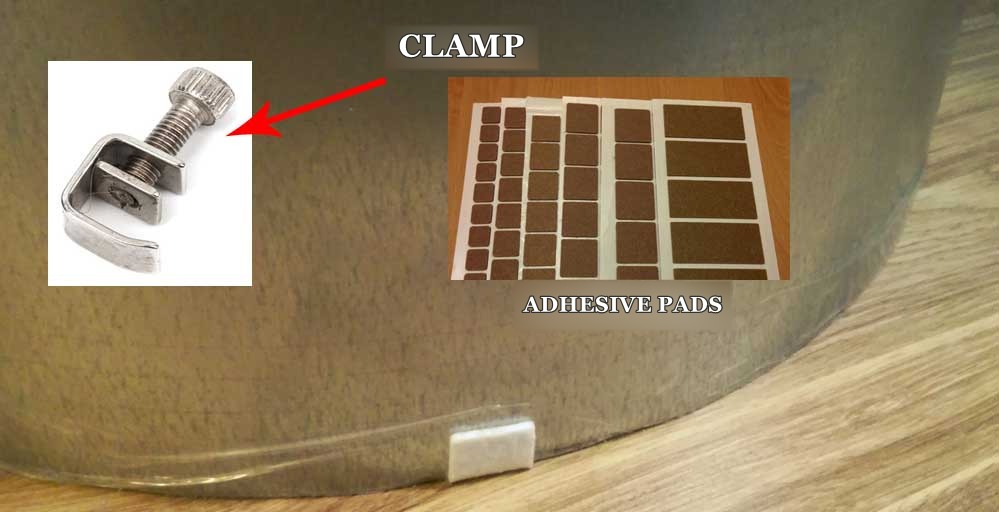
click to enlarge
Once rolled up, the steel sheet takes up very little space. Some people keep large vases at home that only gather dust, whereas this structure is useful. You can drape something over it, an attractive fabric, for example, and it may look rather nice. You could even put an attractive round board and a vase on top, turning it into a tall, elegant and unusual table.
In other words, you can make it as attractive as you wish. You could also fit proper castors, readily available in shops, although that option is not within everyone's reach. Castors make sense if the floor is carpeted and the structure will not slide; they would be more convenient.
When you want to use the concentrator, remove the clamp, unroll the steel sheet to increase its diameter and step inside to practise. In my view, this is the most convenient version for home use.
© Author: Sergey Veretennikov (Om Shanti)
27 June 2018.
When you roll up this concentrator tightly, as described above, the number of layers naturally increases. What does that mean? It means it will work more powerfully. Of course, you will not sit inside, as it will essentially be a narrow tube, but you can place a bottle of water in it, for example. Do you see? The water will stand there and become charged. Use only ordinary drinking water. ("Charging" is an esoteric image; it does not make water medicinal or disinfect it.)
If you cannot make Himalayas-1 at all, you can create a smaller copy, just large enough for a small bottle or jar of water. You can at least drink this special water, even if you cannot sit inside a concentrator yourself.
How do you make it? Steel sheets are not essential for this structure, although you can use them. You can simply use cardboard covered with foil. Make cylinders that fit inside one another, with progressively smaller diameters. This produces a layered tube inside which you place a bottle of water for charging. It is also preferable to close both ends of the tube with the same layered material.
Instead of making separate tubes, you can use a roll. Make a long strip of foil with a backing and roll it to fit the bottle you will insert. I have only given you the idea; there are various ways to put it into practice. Builders' merchants have many useful materials, including insulation with a foil layer, which I mentioned above. It may be enough simply to buy one such roll and make Himalayas-1 Mini in ten minutes.
© Author: Sergey Veretennikov (Om Shanti)
28 June 2018.
Healing Practices | Energy Exchange


