

Unity. Light. Love.
Living Soap


 You all know that shop-bought soap is a chemical product full of substances that are far from beneficial. It is therefore strange to hear people wonder why their skin has aged so quickly. Every day, many times a day, you wash some part of your body and skin with this soap. What is surprising? The skin absorbs all this nastiness. However strong it is, it eventually loses its battle with outright chemicals. Rapid ageing is only half the problem, since many people now also develop various skin conditions. In most cases, soap is to blame.
Moreover, soap is now made from animal bones and fat. That alone is revolting. If most people made their own soap, the need to kill animals for soapmaking fat would fall sharply, so this article is a humane step in that direction. Practically all baby soaps also contain added glycerine to make them transparent. This is outright chemistry... Honestly, I do not even want to list the ingredients of modern soap.
There are ways to make soap entirely yourself. I do not mean melting down baby soap and making something from it, or buying a soap base and using that. The internet is full of "make your own soap" instructions that ultimately amount to remelting ordinary soap. No: I mean making soap completely from scratch, as it was made thousands of years ago, without any chemicals.
What ingredients will we need? Water, any vegetable oil and lye. I also recommend beeswax: it is very beneficial, gives the soap a wonderful scent and helps create a good consistency. Beeswax is easy to buy from beekeepers, honey shops or markets.
You can use any vegetable oil, either a single oil or a mixture: olive, sunflower, sea buckthorn, any nut oil such as walnut, palm, coconut, and so on.
You can calculate your soap ingredients using an online soap calculator.
All these ingredients are easy to buy in shops, readily available and inexpensive. The simplest soap needs only sunflower oil, water and lye. That is all, and it costs very little. You can infuse the water with spruce needles or medicinal herbs to make the soap fragrant and beneficial without increasing its cost.
You may add natural aromatic oils to these recipes as you wish, such as lavender, rose or eucalyptus, to give the soap the scent you want. You can also infuse the water with spruce needles to make spruce soap, or prepare herbal decoctions with camomile, calendula, ginger or rose petals. Add sea salt for a seaside effect. There are countless possibilities. You can also make versions for adults, children and babies, varying their "strength" and, for children, using milk instead of water and more superfat, the creamy component I will explain below.
[ Click to enlarge the image ]
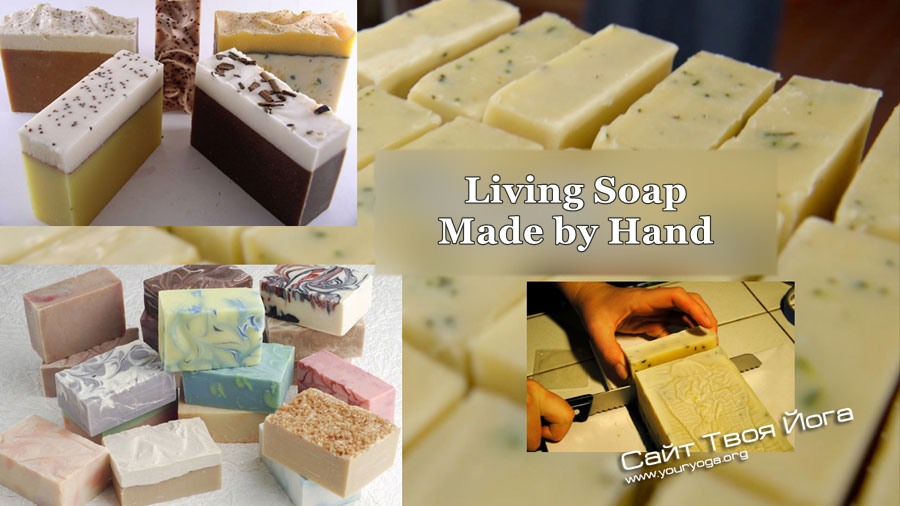
You can divide the soap mixture into two portions and colour each differently. There are many ways to colour it, such as beetroot juice or cocoa. Combine the portions before they set, and you will have two-coloured soap. It looks very beautiful. Naturally, this does not affect the soap itself; it is purely aesthetic. Nevertheless, experienced soapmakers create truly beautiful soap, a delight to behold, with picturesque patterns inside and flowers or leaves on top. All this makes the soap doubly pleasant. You can do it too: divide the mixture into portions, colour them and create patterns. You know how expensive soap sold as "living soap" or "natural soap" can be. Yet you can make exactly the same, just as good or better, and very cheaply. That is the point of this article. You can make a whole kilogram at once at very little cost. Think about it: what could be expensive about water, lye, sunflower oil and, say, a decoction of spruce needles?
As I have said, the simplest soap recipe is water, oil and lye, with superfat added. What is superfat? It is oil that does not react with the lye and is therefore not saponified. You do not necessarily have to add it separately: if you use several oils, a certain proportion will remain unsaponified anyway. This is the oil that gives a creamy effect, nourishing and softening the skin. Add it or leave it out as you choose; it does not affect the cleansing properties. To prevent soap drying the skin, massage with oils after bathing, such as ghee or olive oil. The essentials are water, lye and any oil, such as sunflower oil. That is all. Baby soap, however, must contain superfat, producing something like a cream soap, very mild. In other words, superfat is oil added at the very end of soapmaking. It is not a cleansing agent but remains as oil within the soap.
Detailed video instructions for making your own soap appear below. Watch the video to see the whole process clearly.
As I wrote [ here ], you can make vegetable oil yourself, even growing the seeds or nuts for it. In that case, your soap is truly made from scratch, entirely by you.
You will need scales, because lye must be weighed precisely. In fact, every ingredient should be weighed. Making soap is like cooking a delicious dish: everything must follow the recipe exactly. Estimating by eye will not work, so scales are essential. You will also need an inexpensive hand blender, reserved exclusively for soapmaking and used for nothing else, and soap moulds. That is essentially all the equipment required.
There are two soapmaking methods: cold process and hot process. Hot process is quick; cold process requires waiting at least several days for the soap to mature. The resulting soap is the same, so hot process is preferable because it is faster. In hot process, you keep the soap mixture in a water bath for about an hour and a half at the end. Simply place the saucepan containing the mixture inside a larger saucepan of water over a low heat. The cold and hot methods are otherwise identical; heating greatly accelerates maturation.
Here is the simplest soap recipe:
Olive oil: 300 g.
NaOH lye: 38 g.
Water: 100 g.
You can use this recipe with any oils, with approximate accuracy; a more precise calculation is provided by the soap calculator. The recipe currently uses 300 g of olive oil. If you want other oils, such as grapeseed, apricot kernel, almond, buckwheat or sunflower oil, simply divide those 300 g among your chosen oils. For example: 100 g sunflower, 50 g almond, 100 g buckwheat and 50 g coconut. You may also add 10 g of beeswax if desired.
Do you understand the principle? The lye and water quantities remain unchanged. As mentioned above, the water can be infused with anything, such as spruce needles or herbs, or replaced with milk. You can also use juices: lemon for lemon soap, cucumber for cucumber soap, berries such as strawberries for strawberry soap, apples, and so on.
If you wish, use an online soap calculator. It will calculate everything automatically; you simply choose the oils you want to use.
You can also add tiny quantities of natural essential oils, such as peppermint, rose, clove, eucalyptus or camomile. As you can see, there is tremendous variety. You decide what soap you need and make it entirely from genuine natural ingredients, some or all of which you can grow at your country home.
Now for the actual preparation. The most important thing to remember is how to mix lye with water. Add lye to water, never the reverse. Chill the water first, perhaps in the refrigerator, then carefully add the caustic soda by the spoonful to a jar of water. Mixing lye and water releases a great deal of heat and can literally make the water boil. That is why the water must be thoroughly chilled first. If you instead add water to lye, you can get a veritable firework display of splashing boiling water. Lye is also dangerous on contact with skin. Remember: chill the water and add lye to water, not water to lye. Then the mixing process will not be dangerous. Mix beneath the kitchen extractor hood so that you do not breathe the vapours released. It is best to do everything in the kitchen. Keep children out and close the door. One person should preferably do it alone, since two people would get in each other's way. After mixing the lye and water, leave the jar standing for about ten minutes and leave the kitchen yourself.
Fortunately, many people now make their own soap, and there are plenty of online videos demonstrating the process. Seeing it once is better than hearing about it. I would single out , although I am not saying it shows a perfect technique. Simply watch it to gain a general visual understanding of the process.
I would divide soapmaking into several stages.
The video above shows the basic principle of soapmaking. As I said, hot process is preferable: the result is the same, but it is faster. Cooking matures the soap more quickly than cold process. If you do not want to use heat, at least put it somewhere warm; otherwise, maturation can take up to a month.
You do not have to separate soapmaking into stages of first making a soap base or laundry soap and then the finished soap. Everything can be done in one go.
I will not describe liquid soapmaking in detail. It is similar to making solid soap. Using the online soap calculator , you can calculate the ingredients for liquid soap. The only difference is choosing KON as the lye required for liquid soap. Liquid soap is, of course, much easier: there are no moulds to deal with, no cutting and many other unnecessary steps. It also lathers more quickly. It is practically shampoo, but much thicker. You can put it into special containers with pumps or other dispensing mechanisms.
Most importantly, do not be intimidated by making handmade soap. There is nothing complicated about it. Essentially, you mix water, oil and lye, then cook them. That is all. Online videos may make the process seem complicated or stress the special importance of their particular recipe, discouraging you from trying. Do not be afraid: you can succeed too.
Moreover, making something with your own hands is such a pleasure, quite apart from the fact that it will be living soap, free of chemicals. If you also grow the seeds at your country home, press the oil yourself and then turn it into soap, I do not think words can describe how that will feel.
© Author: Sergey Veretennikov (Om Shanti)
27 September 2015.


