

Unity. Light. Love.
Rejuvenating the Spine


This is not a simple practice. Approach it gradually.
It also requires various devices that you will need to make yourself or obtain somewhere. Fortunately, the twenty-first century makes practically anything available. The usual difficulty is finding the information you need within the endless stream. An abundance of information often merely creates the illusion that you will learn something useful: discernment is also needed to recognise the good amidst a sea of useless or even harmful material.
I have already discussed the spine on the Your Yoga website, but, as I said, here I will give information specifically about rejuvenation. This means the most powerful information. Preserving youth requires one kind of practice; restoring it requires much more than the simple practices that preserve it. Something of an entirely higher order is needed. At the bottom of this page, I have made a video clearly demonstrating the principle described here.
You have all seen children's seesaws. You might think some good person invented them and now everyone uses them. That is how most people think, is it not? Often, no one even wonders who invented them: they exist, and that is good enough. What does it matter who invented them? There is not even a thought that they might be some kind of tool...
Essentially, a seesaw is a board laid across a log. But something tells me you will now look differently at this structure so often seen in playgrounds.

click to enlarge
Nowadays, it is better known as an "inversion table". The same seesaw, with added comfort.
Honestly, it makes no difference to me whether you buy such a table, where or from whom. Buying one is, of course, the simple option. I can only say that you can make such a seesaw yourself. Folding versions are available that take up little space. What I am giving you is the principle, which matters most. How you put it into practice is your choice. I will, however, describe different approaches and possibilities below.

click to enlarge
The principle is this: the feet are secured and the person hangs, stretching the entire body.
What matters is that when a person stands, the greatest pressure falls on the feet, progressively decreasing upwards through the knees, lower back and so on. When a person hangs by their feet, everything happens in reverse. Do you understand? Everything is reversed. The feet now experience the greatest stretching, bearing the weight of the whole body, followed by the knees, hip joints and spine. I emphasised "reversed" deliberately. If you want to reverse life's processes as fully as possible, from ageing towards youth, you often need to do something in reverse. I need hardly tell you how much importance Yoga places on inverted postures. Yet I am not discussing those, because I decided to give you only the most powerful methods. That is why I am speaking about the seesaw rather than the headstand. Please do not write asking whether you can replace it with a headstand. I am not writing this so that you can substitute things. I am giving you a principle.
If the seesaw is not an option, find a board and lean it against a wall, preferably securing it with angle brackets. Fit loops for the feet at one end, and some kind of handle to help you lower and raise yourself. This version is practically free.
The seesaw also lets you change the angle of inclination. Naturally, begin with a slight angle, get used to it, and only then increase the tilt.
Contraindications:
Pregnancy, joint or spinal injuries, stroke and high blood pressure. For greater safety, consult a doctor.
There is an even simpler option, though it is harder to perform for those who do no exercise at all.

This is the most powerful version, but I personally do not consider it essential. You do not have to aim for it; the seesaw is quite sufficient.
If you have a horizontal bar at home, you can use it. Inversion boots are available for this purpose. There is nothing special about them: a hook is attached to a padded fastening around the leg. For example, like this:

click to enlarge
You can make them yourself or buy them. I provide no advertising links, because Your Yoga is free of advertising and I do not make money from people. Search for "inversion boots" or "gravity boots". They are also available in sports shops, as they are used for exercise.
If you have wall bars as well as a horizontal bar at home, you can attach yourself to a rung and lie head-down on a board, creating the seesaw arrangement at different inclinations. While hanging upside down, I recommend joining your palms in the namaste mudra, as the Shaolin monk does in the photograph above.
© Author: Sergey Veretennikov (Om Shanti)
Practice written on 19 November 2017.
Let us continue. Next, you need a horizontal bar. I advise everyone to have one at home, even if it is the only piece of equipment. Even if you do no pull-ups, have one there: perhaps you will start exercising occasionally. Without it, you certainly will not start. Its very presence is motivating.
Better still, something like this:

I have a similar structure. It contains everything needed for a good workout at home. You can even make it yourself: essentially, a few pipes need welding together. You will save on travelling to the gym and on the sessions themselves, which are not cheap nowadays.
So, you have at least a pull-up bar. As I wrote above, you can use it with inversion boots to stretch the whole body if the seesaw is unsuitable. Here, however, we are discussing a different kind of traction. You will need straps for your hands or arms. These may also be hooks working on the same principle as inversion boots, but for the hands. As far as I know, they are called "pull-up bar hooks".
Inversion boots and hand hooks are needed so that you can relax. That is the point. Yes, you can hold on without them and still stretch, but it is less powerful than hanging in a relaxed state. This matters. There are many kinds of hooks and straps. Buy them or make your own; the choice is yours.

How to hang by your hands: in the picture, you can see that the ends of the pull-up bar slope slightly downwards. This makes wide-grip pull-ups more comfortable. Attach your hooks or straps, whichever you find or make, at the very ends, so that your arms spread as widely as possible. This gives a good stretch to particular areas of the body, back and spine. Then stretch with a narrow grip too, combining the two.
Important Note:
In every form of traction described above, relaxing thoroughly is important. This allows excellent stretching. If you resist or hold tension, the stretch will be weak. Nevertheless, with continued practice there will be an effect in any case, and the tension will disappear by itself.
I am not specifying how long to stretch. For some people, it may initially be only seconds. Do not imagine it is simply pleasant enjoyment, especially if the body has become completely stiff by the age of sixty or seventy. Yet as you continue, you will be surprised to see everything coming to life. Childlike flexibility returns, bringing ease of movement and the desire to run and play as you did in childhood. Do not overstrain yourself or do more than you can tolerate. Follow the principle of gradual progress. Even thirty seconds is good. Where there are thirty seconds, forty will follow. Do not rush.
© Author: Sergey Veretennikov (Om Shanti)
Practice written on 20 November 2017.
Now the final exercise: stretching the neck. This too is fairly simple. In your world, this device is better known as a Glisson traction sling. Personally, I do not care what you call it. It is an ancient tool, or more precisely, a principle. You can buy one or make it yourself. Many versions exist; choose one. In some cities, pharmacies sell them. I do not know what you will read online about this device. I am speaking specifically of vertical neck traction under your own body weight. A manufactured version may look like this:

The principle is simple: something must support the head so that, ideally, you could hang by the neck without anything compressing or constricting the arteries, and while remaining comfortable. The essence is to hang by the neck.
Naturally, this traction must initially be extremely gentle. Do not hang with your full weight. Indeed, at first you can attach the sling to an elastic support, such as a medical rubber tourniquet, to cushion the movement and keep everything very gentle.
With practice, people begin simply hanging by the neck and find it comfortable. This means everything has returned to normal. But I repeat: do not chase this result. Do everything gradually.
How can you make one yourself? Essentially, all you need is two straps.

Use your feet to regulate the force of suspension at the neck. Alternatively, adjust the length of the fastening so that sitting on a chair, for example, produces the stretch you need. Moving the chair backwards increases the traction. You do not have to use a chair: sit on the floor and gradually move backwards to increase the stretch. You will understand this when you begin practising. Relaxation is essential. If you tense your neck and resist the stretch, the effect will be weak. There are two approaches: establish a stretch in the neck and hold it, or stretch, release, stretch again and release again, about ten times. Both are good. It is best to alternate them, perhaps using the first one day and the second the next.
IMPORTANT: I repeat that when first using a Glisson sling, you must not immediately apply a heavy load or suspend your entire body weight. Regulate the load through how much support you maintain with your feet, through an elastic support, or by adjusting the fastening length so that sitting on the floor or a chair creates a slight stretch that you increase over time.
All kinds of hernias, disc protrusions, chondrosis and so on are treated. It treats things that cannot be treated in any other way. I will try to explain how this happens.
Essentially, cartilage lies between the vertebrae, as it does between bones. It becomes thinner with age, usually because people move too little and because of gravity. The body, generally weighing seventy kilograms or more, presses on the cartilage every day. Cartilage is not muscle; blood vessels do not reach it, so it receives nourishment only through bodily activity. It is compressed and released, "breathing" like a sponge. Nutrients flow in and out, all through bodily movement. Without movement, cartilage either thins or becomes rigid with waste. So-called intervertebral hernias may also appear. Whatever exercises you do will not help, but traction does. Stretching and compression, stretching and compression: the joint begins to breathe and come alive. Nourishment enters and waste leaves. The same applies to intervertebral discs. They breathe. Every day, stretching nourishes them as they expand and compress. This is literally cartilage breathing. Everything comes to life. You no longer groan when moving, and every movement begins to bring joy.
Our bodies have many joints. Imagine problems in all of them: the whole body aches and hurts. This practice enables you to rejuvenate the spine and every joint.
Internal organs may heal, including the liver, kidneys, lungs and even the heart, for example in cases of arrhythmia. One might wonder what connection there could be between the heart and the spine. Yet the body will begin healing, and you will see it. For some, it may even seem miraculous.
I advise doing all the exercises I have given today, rather than choosing some and leaving others out. They are all important. Here is the plan for one session. For example, take a warm shower in the evening, then begin these exercises as your daily evening routine.

As a consolation for anyone who will still do nothing from this page, I can recommend a simple inverted posture: here. It does not replace these practices, but it trains the blood vessels well. You can also begin it now, preparing your body while you obtain equipment such as a Glisson sling, seesaw or inversion boots. Preferably, practise as follows: raise your legs using a chair or wall, relax and remain there for about a minute. Then stand fully upright, rest for a minute and repeat three to five times. This is excellent training for the blood vessels.
© Author: Sergey Veretennikov (Om Shanti)
Practice written on 22 November 2017.
And, as a supplement, a short video.
This video is simply motivation and a demonstration of what I have written on this page.
You may ask: how can all this be applied to my grandfather or grandmother, who walks with a stick or uses a wheelchair? How can they be rejuvenated?
A good question. It can and should be applied, but gradually. What I have given on this page is only the first practice in a large collection of my methods for restoring youth. Anyone can perform them, even someone with the most severe symptoms of the disease called old age. As I have told you, I regard old age as a treatable disease, at any stage. I am not telling anyone to immediately hang upside down. If you love your grandfather, make him the equipment to work with. At first, he may hang by his hands for five seconds; a week later, ten seconds. The process will begin. What I have given on this page works 100%. Yet this is not everything: I will also write about nutrition, massage and special energy devices...
A year has passed, and many people are already practising my rejuvenation method. I now have feedback and accounts from people that allow me to assess its effectiveness.
The method works wonderfully, but I must repeat what I have already said: do not rush! People write to me saying they immediately climb onto a bar and hang upside down for ten minutes or longer. I wrote that only athletes and people in good shape can begin this way, and even then gradually.
If you are over fifty, even on an inversion table you should initially lower yourself no more than ten degrees below horizontal. Increase the angle week by week. This is no joke! You must not simply take such risks. I repeat: approach it gradually. For some, a maximum downward angle of thirty degrees on such a seesaw will be quite sufficient.
I must mention another very important point. When you hang from a bar by your hands or feet, the muscles immediately beside the spine generally do not relax; instead, they contract even more strongly. This is a paradox: you are hanging, so the body should stretch according to the laws of physics, yet this does not happen throughout the whole body. Our wise body contracts the muscles around each vertebra to stop the vertebrae "escaping" from the spine. This is a protective function. The harder you pull, the more these muscles contract. On an inversion table or seesaw, however, this does not happen. Over time, a person may learn to relax so thoroughly while hanging from a bar that all the muscles release, but this does not happen initially. For some, it never happens, because they read my practice inattentively and overlooked the instruction to relax thoroughly. On an inversion table, the body understands that it is lying down, nothing "frightens" it, and the muscles directly beside the vertebrae relax. These are often precisely the muscles that are severely contracted and particularly need relaxing and stretching. The same applies to the Glisson sling. Aim for maximum relaxation. Often, a small stretch with very deep relaxation is more effective. In this respect, I also recommend hanging by your hands from a bar while keeping your feet supported. Most of the body weight remains on your feet, yet you are also hanging from your hands. The reduced load allows you to hang longer, while the muscles around the vertebrae relax. Combine this with unsupported hanging using your full body weight. The exercises may look alike, but their effects differ, and combining them produces a better result.
Today I want to describe an alternative to the inversion table or seesaw. It may be useful for those unable to make or buy one, who have no horizontal bar, or who cannot even drill a hole in a wall.
You will need only a rubber exercise band, which I have seen sold as an "elastic band", "resistance band" or something similar. Use one long band, about two metres, or two shorter ones, perhaps 1.2 metres each. I will not provide specific links or advertise anyone; you can find them in any sports shop. You need not buy anything: if you have springs from an old bed or furniture, attach ropes at both ends and use them instead, so the ropes stretch like elastic. Pharmacies also sell something similar called a medical rubber tourniquet, as far as I know, but it will not last long. A sports band is better and will serve you for a long time. It is also excellent for exercising at home, replacing some expensive machines. A wonderful item; I have one among my own home exercise equipment.
I will describe the resistance-band version. Suppose you have two. You can attach one to each side of a radiator, left and right, if there is nowhere else to secure them. Make a loop at the other end of each band, either by knotting the band itself or using a broad cord to form a loop around your wrist.
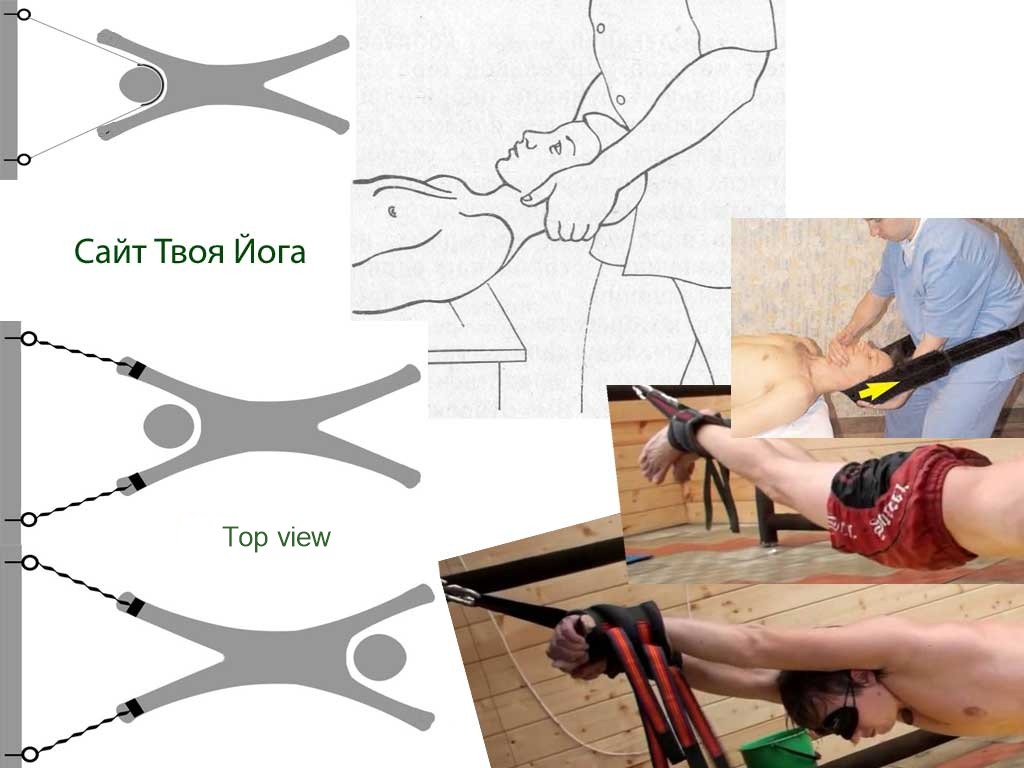
You now have two elastic bands secured to the wall at one end, approximately a metre above the floor, with loops for your hands at the other. Put your hands through the loops and lightly curl them around the far side. You are not gripping the band; the wrist loops hold your hands. Lie on your back on the floor, on something warm so that you do not get chilled, and move away from the wall to stretch the bands. Establish a comfortable pull on your arms. Not only your arms but also your spine, and to a lesser extent your legs, will stretch. Remember that the bands are fixed about a metre above the floor, so your arms and shoulders will be slightly raised, allowing an excellent stretch through the spine, broad back muscles and so on. Remain there and enjoy the stretch. It is genuinely comfortable, like stretching in the morning. In another version, roll along the floor until your arms cross. This helps release spinal tension and work with the joints more effectively.
Then do exactly the same with your legs.
Next, lie on your stomach and repeat everything with your arms and legs, now face down rather than on your back. The illustration below shows it all. It is similar to using a horizontal bar, except that everything is done lying on the floor. All the illustrations below show positions on the floor. This version is especially suitable for those whose health prevents hanging upside down, or who cannot have a bar or seesaw at home. You can also practise with your hands together and feet together.
(click to enlarge)
To finish, here is a magnificent exercise performed by all manual therapists. Anyone who has received it knows how pleasant it is. It stretches the neck and spine: while you lie on your back, the therapist lifts your head slightly and gently draws it backwards. You remain completely relaxed, enjoying the release of all tension from your neck and entire spine, which seems to begin "singing". You can have all of this now, free and at any time. See the illustration above.
As we know, the head is a sphere resting on a cylinder, the neck: a simplified geometric structure. You can pass a towel beneath the head at the neck and use it to stretch the neck. The towel, or a more comfortable fabric arrangement, will not slip off the head. This is a simplified Glisson sling, and also a more pleasant way of stretching the neck and spine. See the illustration above.
You can therefore use the rubber band to stretch your neck in the same way. Place a cloth or towel beneath your head, as though lying into it; see the illustration above. Attach the towel to the band secured to the wall, or to a radiator if necessary. Again, move away from the wall until you create a pleasant tension, then relax. Your head, neck, shoulders and part of the thoracic spine will be slightly raised. Feel how comfortable it is. It is truly pleasant, and you need not pay any manual therapist. Everything is free.
If you doubt that the spine can stretch and that you can even grow considerably taller, something particularly important for older people whose spines shorten and reduce their height, look at this photograph:

(click to enlarge)
These are women from the Padaung people. Other peoples on Earth also greatly elongate the neck. I show these photographs not to suggest that you should elongate your neck likewise, but simply to demonstrate the phenomenon. Our spine can lengthen under a stretching force. This is a proven fact. Yet I repeat: no fanaticism. You can grow taller and reverse spinal shortening, but rushing may cause harm.
© Author: Sergey Veretennikov (Om Shanti)
Practice written on 11 July 2018.
A reasonable question is whether Yoga asanas can achieve the same thing. The question is understandable: asanas require no equipment or construction. You are independent; a small patch of ground or floor can always be found anywhere.
Can Yoga replace these methods? Yes. However, Yoga takes time to master, and not every asana benefits everyone, despite the current belief that it does. You also need to know which asanas produce the required effect. Be assured, these are not merely easy stretches: many asanas are difficult even for serious athletes who have trained on parallel bars or a horizontal bar for years. So the answer is yes, provided you can perform these asanas.
I will not list all such asanas now, only a few of the simplest that can give you some of the effects of the "seesaw". Nor will I discuss who should or should not do them: your doctor can tell you that. I will say only this: learn everything gradually. Gradual progress is Yoga's principal rule.
The first two main asanas are a forward bend towards the legs and a backbend.
First exercise. There are two versions of the forward bend. From standing, bend towards your legs, relaxing your spine as though hanging head-down. Everything is relaxed: arms dangling like ropes, head and torso. Everything simply hangs. Unlike hanging by your feet as described above, only the part below your pelvis is hanging. Practise gradually, and you will be able to bend lower and lower. It is important to hinge at the hip joints, literally folding in half. This will not happen immediately, so progress towards it gradually. You can do the same while seated, bending forwards and folding in half. Do not hunch: the aim is not merely to reach your feet while creating a strong curve in the spine. Ideally, the spine stays straight during the bend. Most people will initially manage only the position shown below, but gradually you will be able to rest your abdomen and chest on your legs.

Second exercise: the backbend. The best exercise here is the bridge, which I also call Chakrasana. It is very well known: you support yourself on your hands and feet while arching backwards. Here too, the head hangs down, as in the first asana. Enter Chakrasana from lying on your back: place your hands on either side of your head, bend your legs and rise into the bridge.

In both postures, aim for ease, without strain. Be completely relaxed and feel as though you are flying; see here. It is in this state that genuine stretching and opening of the joints, vertebrae and so on takes place.
These are the two main asanas. If you only have time for these, do them alone. However, all four exercises are preferable, including the two below.
Third Exercise — a twist, Matsyendrasana — here. There are many variations of twists; choose any. The simplest is to sit upright on a chair, turn left and hold the chair back, then turn right and hold it. Maximum relaxation is needed here too.
Fourth Exercise: lie on your back and stretch your arms and legs as far as possible in opposite directions. After stretching, relax. The effect is this: your limbs, head and spine have moved slightly apart, and you relax in this lengthened position rather than returning to the original state. Each time, try to stretch a little further, beginning from the level reached in the previous stretch. Then turn onto your stomach and repeat.
You may have heard the story of a man who healed himself by stretching. He had been discharged home from hospital as a hopeless case. All he could do was lie in bed, such was his disease of the spine and joints. A full life seemed finished. Imagine everything he must have thought and everyone he must have prayed to. He could do nothing, and the doctors had given up on him. Then the one thing he could do came to mind: stretch in bed. He did it for a week, two weeks, a month, and eventually got out of bed. All the tools had already been in his hands. As the saying goes, heal yourself. Everything is already within us. Even in the most hopeless situations, a hint is given, and everything turns out to be almost laughably simple.
© Author: Sergey Veretennikov (Om Shanti)
Continuation written on 16 April 2019.


