

Unity. Light. Love.
Timekeeping in the Fourth Dimension, in Ediniya


All questions have been grouped by subject and generalised.
Q: Why does fourth-dimensional time have sixty seconds in a minute, just like third-dimensional time? Why are there 180 minutes in an hour rather than ninety or 140? Why are there no milliseconds, and what would they equal in Ediniya?
A: First, understand that, for someone living peacefully, the main awareness of time is which quarter or half of the day it is. In Ediniya, the quarter points are two and six hours, and midday is four hours. Where greater precision is particularly needed, hours are used. There are eight of them. These hours form the basis of the day, rather than minutes, seconds or milliseconds. One second is one heartbeat, so a second lasts the same in the third and fourth dimensions. The heart is not merely an organ: it is the region where the Soul resides. In other words, it is your dwelling place as a subtle-material being, a microcosm. Time is not something abstract and detached from you. You are inseparably connected with it, and it acts upon you personally. The smallest time scale is therefore linked to you through seconds, the beats of your heart, which set the rhythm of your personal time. A mosquito's personal time is different, for example. You cannot catch it with your hand because it flies away as soon as you try: to it, your hand moves as though in slow motion. The same applies to other fast-living, fast-moving animals, such as stoats, whose hearts normally beat very rapidly and which can therefore catch a mosquito. Conversely, tortoises have slower heartbeats, live longer and experience time flowing slowly. Only for Homo sapiens, as a species, does time have its present measure of one second, because of this heart rhythm. Thus, the Earth takes 86,400 seconds, or heartbeats, to complete one rotation on its axis. You will be more familiar with this number from the calculation 60 × 60 × 24 = 86,400. We therefore know that a day contains eight hours or 86,400 seconds. It remains to establish how many seconds are in a minute and how many minutes in an hour. One Ediniya hour contains 10,800 seconds: 86,400 ÷ 8 = 10,800. We now need to divide this by a convenient whole number so that the result is also a convenient whole number. Dividing 10,800 by fifty gives 216; by seventy, 154.29; by eighty, 135. These are inconvenient numbers. Only two numbers are particularly convenient: sixty and ninety. With sixty seconds per minute, an hour contains 180 minutes; with ninety seconds, it contains 120. The Sumerian civilisation used a base-sixty numbering system because sixty is convenient and divisible by ten different numbers: two, three, four, five, six, ten, twelve, fifteen, twenty and thirty. As you can see, it can be divided into quarters, which matters for clocks, unlike ninety, whose quarter is 22.5. Sixty therefore remains the most convenient choice. Dividing 10,800 by sixty gives 180 minutes per hour. In Ediniya, time is also experienced in quarter-hours and half-hours. One might say, for example, "It is half past six" or "The sun will rise at a quarter to two." Half an hour is therefore ninety minutes and a quarter-hour forty-five. All the time scales — hours, minutes and seconds — have whole-number halves and quarters, as a proper clock should.
Q: What about leap years?
A: Very simply, there will be a day numbered 366, once every four years. The principal reference point is the spring solstice. If it occurs after 366 days, the year contains 366 days. This is unlike the current system, in which months not only vary in length but contain inconvenient numbers of days: thirty or thirty-one for ordinary months, twenty-eight or twenty-nine for February. Everything we currently have is very inconvenient and disharmonious.
Q: Why not begin the day at sunrise?
A: Sunrise occurs at a different time each day, making it an inconvenient reference for the beginning of the day. We must also remember refraction: you may see what appears to be the risen Sun when it is actually an optical illusion caused by the Earth's atmosphere.
Q: Why does the day in the fourth dimension begin at midnight, just as it does in the third?
A: We should begin with the fact that someone — who it was no longer matters — divided Earth into twenty-four zones and called them time zones. Each zone is therefore fifteen degrees wide: 1 + 5 = 6, another six in the twenty-four-hour clock; remember also that 2 + 4 = 6. The unit of time is thus the day, the duration of one rotation of Earth on its axis. You know that there are sidereal days and solar days, and also a culminating point of the spring equinox through which the zero meridian is drawn. This was formerly called the "vernal point" or the "first point of Aries", because it corresponded to that sign. A sidereal day is defined by the interval between two passages of the zero meridian through the vernal equinox point. A solar day is defined by the interval between two passages of the zero meridian through the centre of the visible Sun. The sidereal day therefore begins at the upper culmination of the vernal equinox point, usually determined by the star Hamal; this marks the beginning of the day. Understand also that these quantities are not constant and require correction through specific astronomical variables, particularly because the vernal equinox point is no longer in Aries but has moved into Pisces through precession. Many who have tried studying astrology know how much information surrounds this subject and how easy it is to become confused. Simply accept this basic information if you do not want to confuse yourself by hastily reading several astronomy articles on the subject and trying to understand everything at once.
Q: In the fourth dimension, past events are described by the number of years before today. Does that mean days must also be counted backwards compared with our present system? For example: "One year and 320 days have passed", where the 320 days consist of the days elapsed in the current year — say 238 — plus eighty-two days in the previous year back to the event. Is constantly calculating this convenient?
A: When your brain begins functioning at one hundred per cent rather than today's five to seven per cent, it will be as easy as adding two and two. It really will be very simple and convenient. For now, you can simply add "approximately": "About two years have passed", for example. In any case, if you tell someone that an event occurred on 3 August 1354 at twelve noon, their consciousness does not absorb that precision. They would much rather know how long ago it was. They will still perceive the interval approximately: "Ah, that was a little over five centuries ago. I understand; I will remember that."
Q: I still cannot understand how the minute hand moves on this clock. Surely it must go round three times in one hour...
A: No. In one hour, the hand of an Ediniya clock should complete just one revolution. Do not think in terms of the twenty-four-hour scale. If you use an ordinary mechanical clock, as I described in the practice "Time in the Fourth Dimension", I suggested marking a cross on the dial only for convenience, so you can immediately convert ordinary time to Ediniya time. Ediniya clocks are not sold in shops, but this lets you easily adapt a conventional clock into a fourth-dimensional one. Only in this case will the minute hand indeed make three revolutions per hour. On a proper Ediniya clock, however, the hand makes one revolution per hour, only eight in a day.
Q: What about weeks? How many days are in a week?
A: There are no weeks, just as there are no months. The purpose of creating the week was essentially to legalise slavery. It became slavery, though many people do not understand this. In Ediniya, every day is a day off, a day entirely at your own disposal. There is no meaningless slave labour, only a life full of creativity and wonder at discovering the world and yourself. This is a world where love creates, and love has no schedules or quotas. It does not take Sundays off, yet it is always working, deriving immense pleasure from doing so.
Q: Why does the year begin in spring?
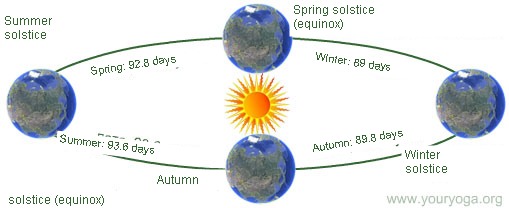
A: This is unquestionably a very special cosmic day, with no other like it throughout the year. At the spring equinox, the Sun, moving along the ecliptic, crosses the celestial equator from the southern hemisphere into the northern. At the Earth's equator, it is precisely at the zenith, which happens only twice a year, at the spring or autumn solstice; the Sun also rises due east and sets due west at this time. Spring begins, and all the Earth's energy awakens. Nature brings forth everything new. It is the beginning of life and the beginning of the year. There was also a widespread custom of joining lovers in marriage on this day, with the appropriate ceremonies performed outdoors in accordance with cosmic principles. Tens of thousands of people also strive to reach the ancient city of Teotihuacan — "the city where people become gods" — on the day of the spring solstice, specifically to stand at the summit of the Pyramid of the Sun. This special day is believed to bring profound purification and transformation. Of course, this may apply to any pyramid. Even simply being calmer and more relaxed on this special cosmic day, and thinking of higher things, allows cosmic energies to pass easily through you and assist your development. Many examples could be given, but the main point is that this is a cosmic day, and people once knew this.
© Author: Sergey Veretennikov (Om Shanti)
Answers published on 23 February 2011.


