

Unity. Light. Love.
Survival Practices


When you wake up in the morning, you wash with hot water; the room is warm. If you want tea, you turn the knob on the gas cooker and immediately have a flame to boil water, or plug in an electric kettle and let it do the job. But imagine the electricity disappears. Something has gone wrong and this energy is gone, everywhere. Immediately, not only hot water but all water stops coming from the tap; the heating disappears; the toilet becomes a foul-smelling pit. Your food is something cold from your stored dry provisions. You go to the shop, but looters have already taken everything. The warehouses are almost empty because officials were more concerned about their foreign bank accounts than people's welfare... Do you think this is unrealistic? It is very realistic. All that separates you from the "external environment", as you call Nature, is the tiny apparent stability of this shaky "civilised" world, as illusory as a mirage in the desert. You need not look far for examples. You see for yourselves in the news that Nature need only increase something slightly somewhere, more snow, more rain, more cold and so on, for all "civilised" activity to collapse, leaving entire cities without electricity, water, homes, and so on.
Moreover, there have been solar flares directed towards Earth that completely halted electricity supplies. On 13 March 1989, this left the city of Quebec, Canada, without electricity for nine hours; everything stopped. In New Jersey and England, transformer installations melted, transformers costing tens of millions of dollars. In 2003, magnetic storms caused accidents at transformer stations in Europe. As a result, electricity was cut off in northern Sweden, and the NASA satellite ADEOS-2 failed completely. The radiation storm was so powerful that NASA advised the astronauts on the ISS to put on spacesuits. A similar situation occurred in January 2005. The point is that charged particles, the so-called solar wind, interact with the charged particles "flowing" through wires, what you call "current". When the solar wind generated by flares is strong enough, transformers, power grids and power stations cannot withstand it: they may simply burn out, leaving entire cities without electricity. What if the solar activity lasts for weeks? After those weeks, you will see for yourself how dependent you are on artificial civilisation, that you literally cannot live without it. If you want to live, you need to remember or learn new Knowledge that will help you survive without the fleeting illusion that "civilisation" will always be able to protect you.
Earth is now like a pregnant woman whose hormone levels are several times above normal. She cries, laughs, becomes nervous, and does not understand herself or what is happening to her. So anything at all can be expected of her tomorrow. She is undoubtedly beautiful, especially in this rare condition. Something wonderful is about to be born, but childbirth is childbirth: both pain and joy. We need to be ready for anything.
Wherever you go, whether hiking, travelling somewhere, flying and so on, always carry the following: an outdoor knife (these look like hunting knives, but are freely sold and require no permits), a sleeping bag, a litre of clean water, a compass, a map, a lighter (preferably two, in case the first fails), a candle, paper for starting a fire (a book or magazine will do), and dry food, preferably hard biscuits. I also advise you to carry 5–10 metres of strong rope and a piece of synthetic fabric about 3 by 4 metres, for making a simple tent by draping it over a rope tied between two trees. On a hike, never entrust anyone else with carrying all these things. You must not end up like Masha, who gets lost with the terrible thought running through her head: "Kolya was carrying my sleeping bag; Vadim is in charge of lighting fires; Nikolai handles navigation and has the map; Lena, who looks after the food, was carrying our water... My rucksack is full of measuring equipment. What am I going to do now?" You must always rely on yourself. Do not entrust your sleeping bag and other essential survival equipment to any Kolya or Vadim: carry everything in your own rucksack. It may save your life.
 Above, I described several reasons you might suddenly find yourself in the cold. These are reasons beyond your control. It might happen like this: you wake up in the morning, and it is bitterly cold all around. The radiators are cold; there is no water, gas or food, nothing, because everything depends on electricity. Another possibility is that the usual winter temperature becomes not minus 30 degrees but, say, minus 60 to minus 90 degrees. Then even a boiler house beside your home will not help. You will have to do something extraordinary to survive. There are other reasons you might find yourself in circumstances where survival depends on whether you can cope with the surrounding cold. For example, your plane crashes in an uninhabited area in winter. You survive the crash, but still have to reach somewhere inhabited to avoid freezing. Or perhaps you were travelling with friends in the wilderness in winter or in the mountains, and something went wrong: you got lost, were caught in an avalanche, and so on, leaving you alone in the cold. There may be many situations, but all require an answer to one question: how do you survive the cold?
People differ. Some are naturally as hot as stoves. Even in winter, they can walk around with their coats open, steam rising from them. These are usually people with powerful, broad chests and truly strong hearts by nature. Others wrap themselves in three blankets and feel cold even at home at room temperature. I can say with certainty that they have one of three problems: a weak heart, weak lungs or an unhealthy liver, or all three. You can only overcome these problems by beginning to improve and strengthen your health. You need to start doing something about it. Running is the best remedy for you. If you do not want to run, take up aerobics, swimming, gym training, skiing, and so on. Do something; take up an active sport, and your sensitivity to cold will pass. Otherwise, your life will depend directly on the city, on civilisation, and if it disappears, you will have almost no chance of survival.
I will also give it a second name, "The Second Heart", because I will later give you a practice called "The Third Heart", so that the two form a pair.
The key to warming the body is blood. Why did I begin this cold-survival practice by discussing people with an unhealthy heart, lungs or liver? Because the blood depends directly on these organs. If they are unhealthy, life in the body barely flickers, as the saying goes. So all you need is to get the blood circulating well throughout the body and supply it with oxygen, which produces heat through oxidation; in other words, it burns, because, as you know, burning is the process of oxidation. Burning means heat, which in this case will allow you to live rather than die where others may perish.
During this walk, you can actually imagine that your whole body consists of tongues of flame dancing in a fire. This is optional, however; do it if you wish.
I do not undertake to tell you how to live, how to continue living without civilisation if it should suddenly cease to exist. I think that if you survive for more than a week using the recommendations above, your experience will guide you from there. Simply follow your experience, your inner guide. Nor am I claiming that the events described above will necessarily happen to you. None of this may ever happen. But there are many people on the Planet to whom it has already happened, and they are no longer with us. So arm yourself with Knowledge and begin fighting for your life and the lives of your loved ones now. Do not rely on everything always being as it is today. Tomorrow, everything may be entirely different.
© Author: Sergey Veretennikov (Om Shanti)
The practice "Surviving the Cold" was given from 15 February 2011.
 There is no longer anyone on Earth who has not encountered abnormal heat, either personally or through the experiences of close friends or relatives. The relentless statistics show that as the planet's climate grows hotter, mortality increases, with the increase accelerating every year. Heat literally kills: it enters people's homes and takes the lives of those who are unprepared for it.
I will consider various situations in which you may need to survive extremely hot conditions, but the main focus will be the survival of an ordinary city resident when heat comes to their home and persists for many days. We are no longer talking about ordinary heat that is merely unpleasant and uncomfortable for the body, but about very distressing and often life-threatening conditions. Not a single unusually hot day that you can simply get through by sitting with a friend who has expensive air conditioning, for example, but prolonged heat. And it is not necessarily just 35 degrees. What if it is 35–55 degrees, or higher? And what if you are not somewhere by the sea with a pleasantly cooling breeze, but in a stuffy flat where an ordinary person is trapped like an animal in a red-hot cage, with dreadful air beneath the scorching sun?
Let us begin. First, I must say that an air conditioner is beyond the reach of an ordinary person, not only because of its price but also because of the difficulty of installation and subsequent maintenance. Do not imagine that you will buy an air conditioner (paying for it), have technicians come and install it (paying again), and then enjoy cool air for a very long time. No. It contains many cartridges that need constant replacement, refrigerant that needs topping up, and so on. All this is in the "box" of a huge fan that hums outside your window, fixed to a vertical wall, dripping condensation onto the neighbours below. Imagine it at the height of the eighth floor or above: you have to call technicians again, and pay again, quite a lot... In other words, for an ordinary person today, buying an air conditioner means buying a problem. That is why many people do not have one and most likely never will.
There is, however, a different solution I want to give you. This is a natural cooling method, rather than the artificial method used in air conditioners. I use it myself, and it works wonderfully. I also use another version, which I described here: "A DIY Air Conditioner, Humidifier and Air Purifier". The method relies on the evaporation of a liquid, in this case not refrigerant but water, ordinary water. As you may know from physics, when a water molecule separates from the liquid, the process we call evaporation, kinetic energy is used to overcome the attraction of other molecules, causing the liquid to cool.
For many people, making this air conditioner will take only two or three minutes. Almost every flat already contains everything needed: any fan and any basin, or another wide container for water. All you need to do is fill the basin with cold water and place the fan beside it. Position the fan so that its airflow strikes the water's surface at an angle. Fans come in different designs; simply arrange yours roughly as shown in the picture below. If the head of your fan does not tilt downwards, for example, you can tilt the whole fan by putting something flat beneath its rear support or stand, so that the blades blow directly onto the water in the basin. As you can see, there is nothing complicated about it:
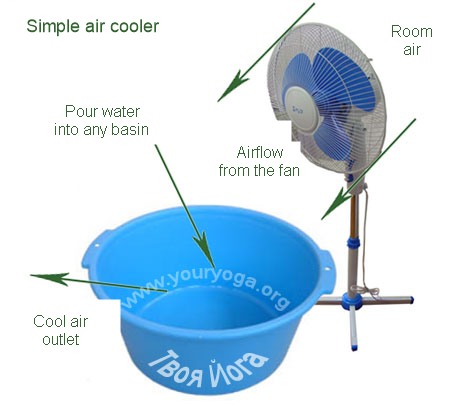
If you do everything as I have described, this arrangement can cool the air by five degrees or more. Moreover, the air in the flat becomes more humid because the water is evaporating actively, and, as you should know, heat is much easier to tolerate in a more humid climate than in a dry one. I would also add that the hottest period of the day is limited, with the peak occurring around midday. At that time, you can put ice cubes from the freezer into the basin. You may be even more surprised to learn that this air conditioner also cleans the air in the flat, and heat is easier to tolerate when the air is clean too. The air "strikes" the water forcefully, and most airborne particles "stick" to the water's surface. Incidentally, this is the principle behind so-called "air washers", which are also sold at quite high prices, whereas here everything is practically free. Best of all, no replacement cartridges or filters are needed. Water does everything, ordinary water. You simply change the water and pay for nothing, while enjoying the most natural air purifier, humidifier and conditioner. Of course, the stronger the fan and the larger the basin's surface area, the faster the water evaporates and the stronger the cooling effect. It is also advisable to position this air conditioner so that the air deflected from the water blows towards you, placing you in the area of cool air.
Someone reading this part of the practice may suddenly think, "Why not buy a humidifier, then?" and buy what is commonly sold: an ultrasonic humidifier, which creates mist very quickly and rapidly raises humidity to seventy per cent or more. I strongly advise against this. Ultrasound is very harmful. The arrangement described above can easily raise humidity in a flat from a very low level to sixty per cent or more.
By and large, the air conditioner described above performs these functions. In hot weather, humidity in city flats drops sharply, sometimes to just fifteen per cent. This is extremely low, not only for tolerating heat more easily but for healthy human functioning in general. Humidity should be at least fifty per cent; the best range is seventy to eighty per cent.
Now I will explain a simple way to measure humidity in your flat. You need an ordinary thermometer, the kind many people have hanging near a window. If you do not have one, you can buy one for very little money. I do not trust expensive electronic ones: they give very inaccurate readings. It is much better to make an analogue device, the most accurate kind, which I will describe. In the photograph below, you can see two types of thermometer. The first is preferable: its scale is embedded in the tube itself or marked on the glass. This is simply for convenience, however; it will not affect the quality of measurement if you have only the second, more common type. In the photograph of the second type, you can see how I dismantled an ordinary thermometer, removed its working core and outer glass casing, and taped the working part to the scale. I then wrapped a small scrap of cloth around the bulb. That is all: the instrument is ready. Your thermometer may be different, but the principle is the same: tie a scrap of cloth or simply a thread around the bulb so that it holds one or two drops of water.
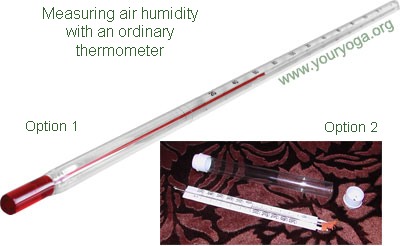
Now place the thermometer on a table, for example, for two or three minutes, preferably with the bulb unsupported, perhaps over the edge. Let the temperature stabilise, because holding the thermometer in your hands distorts the reading through the warmth of your hands. Then read the thermometer. Suppose it shows 25 degrees. Now take it, dip its tip into room-temperature water and put it back in the same position. The water on the tip will evaporate, lowering the thermometer's reading. After three to five minutes, no longer, read it again. Suppose it now shows 22 degrees. We then consult the humidity table using these two values. View the Humidity Table. Open the table and find 25 in the left-hand column: that is the temperature we measured with the dry thermometer. Now calculate the difference: 25 − 22 = 3. Find 3 in the right-hand part of the table. At the intersection of these values, you will find the humidity in the flat. In this case, it is 77 per cent, a very good figure.
If your humidity is below fifty per cent and it is very hot outside, you can use what is called a houseplant mister, also known as a spray bottle or atomiser. I think you already know what I mean. It is a simple device that screws onto a bottle, such as an empty fizzy-drink bottle filled with ordinary tap water. Pressing a small lever with your fingers produces a cloud of finely sprayed water. It costs very little and may already be in your home: some cleaning products are sold with one attached.
It is usually best to do this at the peak of the heat, around midday. Fill the bottle with cold water and, holding the sprayer slightly above your head, spray evenly, step by step, throughout the room's open space. I repeat: spraying should produce a cloud of water like mist, not a jet. This cloud evaporates almost instantly, barely reaching the floor. The procedure has two effects: immediate humidification and cooling of the air, because, as I wrote above, evaporation causes cooling, a law of physics. This can instantly lower the temperature in a flat by five degrees or more. If you want to feel even cooler quickly, stand near the fan and spray water in front of you. The droplets will evaporate several times faster in the airflow, and genuinely cold, refreshing air will blow towards you.
I have already described a simple air purifier above. You can also hang gauze over the window and moisten it from time to time with a water sprayer, because an enormous amount of dirt enters through the window. Damp gauze is good at trapping dust and other airborne particles.
Another option, of course, is to buy an air purifier within your budget. I do not recommend chemical purifiers of any kind. There are many mechanical filters designed to trap coarse particles like a sieve, just like nanotechnology-based water filters in which only water atoms pass through the membrane. Pay attention to this criterion when buying an air purifier. City air is very poor, so an air purifier is simply essential; clean air makes heat easier to tolerate.
A very large proportion of heat enters through the windows, as those whose windows face the sun know particularly well. You therefore need protection from sunlight, but not from the inside with curtains. Make the effort to shield the windows from the outside so that the heat does not enter the room but returns to the atmosphere. Use whatever options you can afford: external blinds, outside curtains, shutters, and so on. If you have none of these and do not expect to install them, the simplest method is to take adhesive tape and newspapers. Use small pieces of tape to attach several newspapers to the outside of the windows. This will block sunlight and reduce the room temperature by five degrees or more.
Also switch off appliances during hot weather. A running computer, even a small laptop, is already a heater in the room: feel its underside and its power supply, for example. A light bulb is a miniature heater, and so on. Be aware of this. Following this rule will also lower the temperature.
There is an excellent method known to many Indian women: wearing jewellery made of natural stones. Natural stones, I particularly emphasise. These are inexpensive stones, such as tourmaline, agate, jade, malachite, serpentine, carnelian, and so on. In India, bracelets and necklaces made from such stones cost practically nothing. In ancient times, women might wear literally tens of kilograms of them. There is gemstone jewellery for both women and men. It should be worn: it offers powerful protection and help. Choose stones you like. In the context of this practice, however, I can say that all of them help in hot weather, so feel free to wear any natural-stone jewellery you have. It is very good if it weighs at least 200 grams, preferably more, as this will provide a good cooling effect.
A damp wrap over your shoulders, such as a thin towel, helps very well. Simply soak it in cold water, wring it out and place it over your shoulders. This provides effective local cooling and a real feeling of coolness.
I am confident that if you use these methods, even when it is 50 degrees outside, you will feel comfortable in your room, as though it were 25 degrees, for example.
Above, I considered the simplest situation, one very relevant to many millions of people. Now I will consider a more specific case: suddenly finding yourself somewhere where heat is Nature's normal condition.
In the practice "Surviving the Cold", I said that cold is indeed deadly dangerous but that there is certainly a chance of survival. Now I am saying that if you encounter heat in the wilderness, in desert conditions for example, your chances of survival are very small. The problem here is not so much the heat itself as water.
That probably exhausts the ordinary methods and recommendations, so I will move on to the unusual ones.
© Author: Sergey Veretennikov (Om Shanti)
The practice "Surviving the Heat" was given from 25 June 2011.
This practice will be continued. As always, you can easily find out about further additions in the Your Yoga website News.


 Surviving the Cold
