

Unity. Light. Love.
A Sense of the PATH


 A Sense of the PATH
Before reading, bear in mind that this practice is so simple you may overlook it. If you approach it superficially, you may not even recognise it and ask, "Where is the practice itself?" Pay attention so that you do not miss it.
People generally fall into two categories: those who occasionally step onto the Path, and those who occasionally step off it. You may want to reread that sentence, asking, "Isn't that the same thing?"
Outwardly, the two may indeed look identical. What matters, however, is not the event but your attitude towards it. This is the subtle, barely perceptible point I warned you about at the beginning.
What you regard as your Path does not matter here, nor does what you believe or practise. Each of you considers something to be your Path: going to a temple to pray, meditating, repeating a mantra, practising yoga or qigong, stopping thoughts, and so on. Whatever your Path is, this practice will suit you completely.
Your Path is clearly interrupted from time to time; it is not a straight line, or you would not be reading these words. Things happen that make you forget it and then remember it again. Depending on which category you belong to, you say either, "I stepped off my Path and occupied myself with irrelevant things, but now I am on it again", or, "It was good to follow my Path. Now I have to return to ordinary life, but soon I will find time for it again." Do you feel the difference? In the first case, the main line of your life follows your Path and you occasionally leave it. In the second, that line follows worldly routines and concerns, and you occasionally step onto the Path before returning to routine.
If this is still unclear, I have illustrated it in Figures 1 and 2 below:
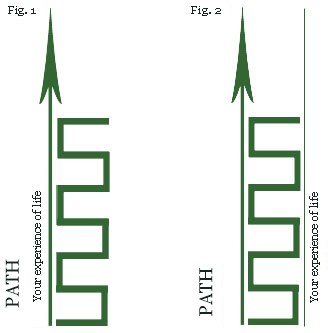
The first picture shows a person leaving the Path towards the right, into life's routine, and returning to it: they identify their life with the Path. The second shows someone who identifies life with ordinary routine, stepping onto the Path only from time to time before returning to their starting state. In the first case, both the Path and the sense of one's life remain on the left; in the second, they lie on opposite sides.
Let us examine a concrete example in more detail. Take someone whose Path is meditation. He works, has various responsibilities and a personal life, and also meditates. He wakes in the morning, attends to small tasks and sits to meditate. He then goes to work, returns tired, does household chores and finds thirty to sixty minutes for evening meditation. During the week, he meets his girlfriend, drinks wine and has sex. At the weekend, he meets an old friend. They drink spirits, smoke, eat meat delicacies, watch a pornographic film and talk as they did as students, swearing and remembering their eventful youth...
Now consider two possible senses of the Path in this situation:
Do you feel the difference? In the second case, your Path almost seems to distract you from, or interfere with, everyday life. In the first, everyday life distracts you from your Path. Everything depends on where you centre yourself and how you position yourself in relation to it. In the first case, your Path will grow stronger, with fewer and fewer gaps until it becomes one continuous, bold line. In the second, you risk losing it entirely. One day you may forget what a Path is and why you need one, dissolving into the grey mass of ordinary people.
Look carefully at which category you belong to and draw your conclusions. The practice is very simple. You need not change anything outwardly, only reorient yourself inwardly: do you live an ordinary life and occasionally step onto the Path as though it were a hobby? Or do you steadily follow the Path, occasionally straying but returning, regarding yourself as having deviated only temporarily?
Practice given on 18 April 2010.
© Author: Sergey Veretennikov (Om Shanti)


