

Unity. Light. Love.
Psychoactive Audio Programme
The Mantra of Enlightenment


 This programme follows the same principle as the other psychoactive audio programmes: you should listen in a relaxed state, which I will describe below.
The programme consists of one very important mantra. I want to explain it from the outset, because you should know what it means.
It all began when the Buddha revealed the Truth to his disciples over 2,500 years ago. According to the official account, it was written down in the first century BC as the Lotus Sutra. Later, further passages were added, and it was translated from Sanskrit into Chinese and then into Japanese.
The Buddha was sitting with thousands of disciples on a mountain now called Vulture Peak, known in his time as Gridhakuta. It is an enormous rocky crag that you can still visit near Rajagriha in India. Even today it is a quiet, pure place that inspires unusual reflections on the meaning of Being.
Thousands of enlightened arhats sit around the Buddha, awaiting a sermon from their great Awakened One. The Buddha closes his eyes and enters a deep meditation, remaining in it for a long time. While he is in this state, a ray of white light emerges from between his eyebrows and illuminates the entire Universe. Through it, all his disciples see a mystical vision of the world: countless Buddhas throughout the Universe engaged solely in preaching the great Truth.
Afterwards, Shakyamuni Buddha revealed to the whole gathering the supreme Truth now known as the Lotus Sutra. Many spiritual leaders still recognise it as one of the highest scriptures on Earth, containing the supreme Truth. Above all, the Buddha explained and showed—his disciples could witness it through his mystical power—that all Buddhas in all worlds, including himself, Shakyamuni, are merely illusory manifestations of the one eternal Buddha, and that no being in any world is incapable of attaining Enlightenment. In other words, anyone can become a Buddha, regardless of anything.
To understand the Lotus Sutra correctly, you first need to know how the Buddha taught. He might tell his disciples something, only to say a few days later that everything he had told them was wrong. Or he might speak to visiting laypeople or beginning Seekers in his disciples' presence and say something entirely different from what he had told his disciples about the same subject—often even the opposite. In other words, the Buddha gave one truth to his disciples and a completely different truth to laypeople or beginning Seekers. He explained to his disciples that Truth must be presented to each person according to their level. So, when he expounded the Lotus Sutra to the thousands of enlightened beings seated around him, he said outright that everything he had previously taught was not the Truth. Only now would he reveal Truth in its pure form. That is the Lotus Sutra. You therefore need to understand how important this is.
For some time, the Buddha's teaching was transmitted orally. Later, it began to be written down as sutras, together with commentaries. Thus the "Sutra of the White Lotus of the Supreme Teaching", or simply the Lotus Sutra, was first recorded. It was originally written in Sanskrit, then translated into Chinese and later Japanese. We now have a sutra that runs through three cultures: Indian, because the Buddha lived in India; Chinese, because China embraced Buddhism; and Japanese, because the Japanese found something very close to them in the Lotus Sutra.
I should emphasise that I am speaking not of Buddhism as such, but of its Essence, which the Chinese and Japanese saw in the Lotus Sutra. I mean only the schools that cultivated the Truth the Buddha expressed in it. Schools therefore arose in succession, first in China and then in Japan. These schools studied only the Lotus Sutra. As this Truth drew closer to Japan, the focus on the sutra itself became narrower and narrower. Eventually, in Japan, the enlightened master Nichiren (1222–1282) founded Nichiren-shu on the basis of the Tendai school, which had come from China. He reduced the practice to its simplest form, concentrating it into one short mantra containing the entire essence of the Lotus Sutra.
The mantra is pronounced:
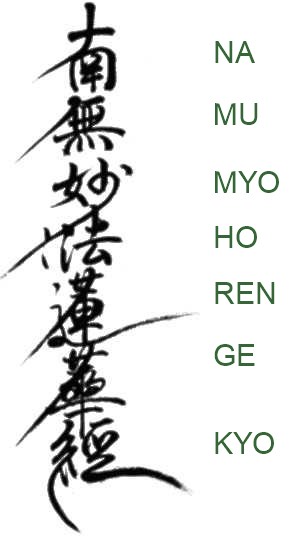
It consists of seven characters whose essence is difficult to translate into other languages. One rendering is "Glory to the Lotus Sutra of the Good Dharma". But do not imagine it is that simple. This is only a very superficial meaning, pointing to its connection with the Lotus Sutra.

The seven characters form five words. In the broadest terms, they can be interpreted as follows:
A fuller translation of this mantra is: "I dedicate myself to the inexpressibly profound and wonderful Truth, the Law of Life set forth in the Lotus Sutra, which embodies the Buddha's highest teaching." Chanting it brings a person into contact with Buddha-nature, which immediately begins to manifest within them.
It is a remarkable mantra. Three great cultures intertwine within it: Indian, Chinese and Japanese, each of which has given humanity many enlightened Masters.
The enlightened master Nichiren called the practice of repeating this mantra "Daimoku". He guaranteed that it alone could bring Enlightenment, such is the power of the Buddha's Teaching contained in the Lotus Sutra.
Let me digress briefly and recall the Beatles. You all know how interested they were in Indian teachings. Here, however, I want to speak about John Lennon's wife, Yoko Ono. She also devoted much time to music and singing. In 1974 she released an album containing a song that was not really a song, but the chanting of this mantra: the entire track consisted of Yoko chanting "Na-mu-myo-ho-ren-ge-kyo". You also know the almost mystical influence this petite woman had over John Lennon, to the point that, essentially, he sacrificed the immensely famous Beatles because of her. What I mean is that although this mantra is little known worldwide, it is held in very high esteem in Japan.
Master Nichiren said of this mantra: "The mind cannot comprehend the scale of the help bestowed on people by the Law of Life during Daimoku practice, for it is boundless. Utter the words of Daimoku aloud once, and they will immediately call to you the beautiful Buddha-nature of the universe, which will surround you with tender care and grant you priceless support." Through Daimoku, a person discovers and realises the Buddha's world within. Nichiren said he gave people this simple method of Enlightenment partly because, in our age, they can no longer understand the meaning of the Lotus Sutra. Yet by repeating this mantra, they receive results as immense as if the Buddha himself were teaching them directly and revealing its secret meaning. In other words, all that is necessary is to repeat the mantra; you need not know the essence of the Lotus Sutra at all.
It is also noteworthy that monks of this school recite the mantra before a copy of a text written by the school's founder, Master Nichiren himself.

This text contains Chinese characters, Sanskrit and Japanese characters. In other words, it is something like a yantra, a mandala or a written Truth that has passed through the layers of three cultures, been enriched by them and adapted to our times.
To practise with this programme, download the file using the link below. It is a recording of the mantra being chanted—Daimoku—lasting exactly one hour.
The mantra is very powerful. It alone can raise your consciousness to a very high level. It is quite possible that at the beginning of the practice, you may dislike something about it, as though something inside you opposes it. This indicates that some part of you contains negative energy or lower consciousness resisting its own destruction. Once the mantra removes this negative part, everything will seem beautiful and conducive to Enlightenment.
Before working with this recording, first watch the video I made for you to help you become receptive to the mantra.
If you enjoyed this practice, you can take it further and repeat the mantra yourself using prayer beads.
© Author: Sergey Veretennikov (Om Shanti)
7 December 2013
Return to the section: Psychoactive Audio Programmes


