

Unity. Light. Love.

| Saturday, 25 November at 10:59 (2017) |
Bhagavad Gita, chapter 4, verse 38.
Na hi (vidyate) — nothing is known; vidyate — to know
Jnanena sadrisham — like knowledge
Pavitram — pure (sinless, holy, sacred)
Tat — this
Svayam — oneself
Yoga-samsiddhah — perfection in yoga
Kalena — in time
Atmani — deep within oneself (in the Atman, in the heart)
Nothing here is known to be as pure as Knowledge.
One who attains perfection in Yoga discovers this knowledge within themselves in time.
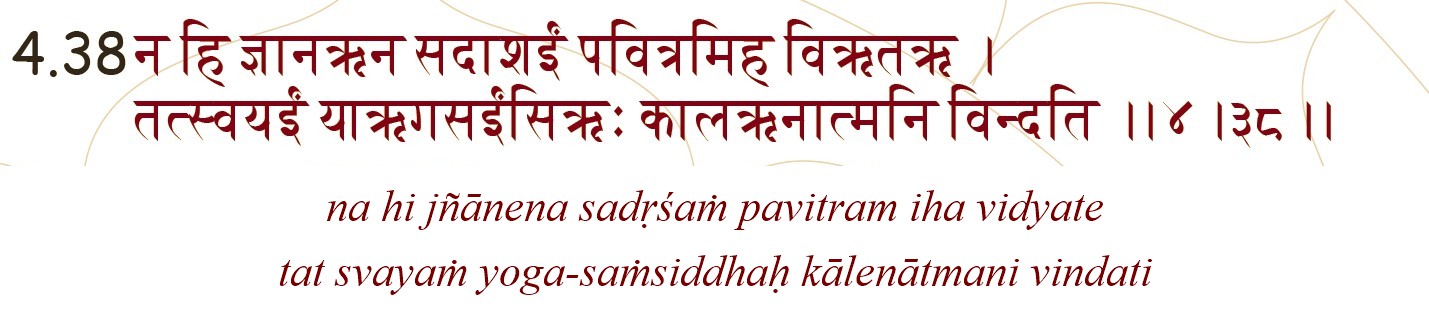
(Translation: Om Shanti, Sergey Veretennikov)
A very important verse. It says that Knowledge reveals itself in someone who practises Yoga. It is not told, shown or written by someone else; it reveals itself within the yogi.
You cannot tell Knowledge to someone. You cannot read it somewhere. This is the mistake of modern “yogis”: they think they already know everything after reading clever books or listening to clever people.
No. It clearly says that Knowledge arises within the person of its own accord. But the conditions for this must be created. As a rule, a Guru creates those conditions.
He helps prepare the ground for this Knowledge to reveal itself within the person.
No Guru will say he can teach you anything. No true Guru.
You cannot teach someone what they already know.
Here is an example. A person is asleep. At present, they do not realise they are human. They are dreaming. Perhaps they are a bird flying over the earth, or a warrior fighting for their ideals. It does not matter. Someone wakes them, and they recognise themselves as human. The one who woke them did not make them human, give them this body or explain a philosophy of who they are... They simply created the conditions for the person to recognise themselves as human, which they had always been.
Sometimes that Guru may be another person; sometimes circumstances, or Life, as people say. Something falls, thunder rolls outside, a dog barks, and the person wakes. But these are exceptions.
The key word of this verse and of the entire Bhagavad Gita is Yoga. This is the key verse of the whole great book.
Yoga is what will awaken you. Real Yoga, however, not gymnastics called Yoga.
Yoga is connection with God, the path towards Him. Christians, Muslims, Buddhists: they all practise Yoga. It is a very ancient art.
It is impossible to say exactly what Yoga is. I would call it any action a person undertakes with a sincere desire to know God. Not only to know Him, but to give Him something pleasing. In other words, a relationship.
Psychiatry surely considers such thoughts some kind of illness. Why seek a relationship with someone you cannot even see?
Yet, in their own time, everyone begins to feel an immense space in their soul that is painfully empty. They try to fill it with cars, flats, clothes, swimming pools beside the house, millions in the bank, sex and so on, but none of this makes that space any less empty. The person feels profound sorrow. Then the psychiatrists return and say: here is a pill, take it every day and become a vegetable.
No one will help you resolve this central problem of yours. No one. Without a sincere desire to move towards God — to practise Yoga — nothing will help. No Guru, no Ashrams, no Scriptures.
But if a person decides to practise Yoga, everything will help them. The Guru's words will immediately become clear. Ashrams will become places where no one forces you to do anything, but simply creates an environment for your development. The Scriptures will become not dogma, but an attempt to direct your energy towards God.
The next verse, verse thirty-nine of the same fourth chapter, is also noteworthy.
shraddhaval labhate jnanam tat-parah samyatendriyah
jnanam labdhva param shantim achirenadhigacchati
shraddha-van — a person possessing faith; labhate — obtains; jnanam — knowledge; tat-parah — striving to obtain it; samyata — restrained; indriyah — the senses; jnanam — knowledge; labdhva — having received; param — supreme, transcendent; shantim — peace; achirena — very soon; adhigacchati — attains.
A person filled with faith, who has restrained their senses and earnestly seeks spiritual knowledge, is worthy of receiving it. Upon obtaining it, supreme peace, shanti, comes to them at once.
In other words, Knowledge is not the final goal. It says here that the goal is Shanti. Only when you are filled with Shanti can you love, be kind and be a source of Knowledge.
© Author: Sergey Veretennikov (Om Shanti)
| « Read All |


