

Unity. Light. Love.
KALACHAKRA. Mastery over Time


Kalachakra was transmitted to the king of Shambhala by the Buddha himself, Shakyamuni. This knowledge was preserved only in Shambhala for a long time, until the great mahasiddha Chilupa, an Indian yogi, visited Shambhala and received initiation into Kalachakra. Afterwards, knowledge of Kalachakra first spread throughout India, then reached Tibet, where it is today the crowning achievement of Tibetan Buddhism.
At present, knowledge of Kalachakra is available to us in the form of a mantra, a mandala, including a three-dimensional one, and a special symbol made of the interwoven Sanskrit letters of the Kalachakra mantra. All of this is presented in this film.
It should also be noted that we are not speaking of Tibetan knowledge or Tibetan religion. In fact, this knowledge is not only non-Tibetan; it is not even religious. It is a historical fact that belongs to all people. If you do not yet know about it, watch this short film to gain a quick understanding of the depth of this Knowledge.
We can say that meditation on Kalachakra is one of the paths leading to Shambhala, to its knowledge and to communication with the Mahatmas.
This is an attempt to calculate his approximate arrival in terms of our modern calendar, because what is written in the Vedas does not refer to our years. Attempts to compare different units of time therefore lead to misunderstanding.
The Vedas mainly speak of the Yugas in which particular avatars of Vishnu appeared.
All these avatars were recorded in the Vedas before they appeared. This is unique. For example, Rama had not yet come, but his arrival had already been recorded and described. When Rama appeared, everyone already knew that he was an avatar of Vishnu. The same is true of the later avatars, Krishna and Buddha. And the same may be true of Kalki, who has also been described but has yet to come.
Let us try to understand, using the information available to us, when Kalki might come. He is a very important avatar, because with his arrival the world will change: evil and everything bad will be destroyed, and a new life will begin in a new golden age inhabited only by the righteous. It is therefore very important to know at least approximately when to expect this event, the appearance of Vishnu's last avatar.
Fortunately, two reasonably precise dates have come down to us: the arrival of Krishna and the arrival of Buddha. These are the two historical events closest to us, dated in modern chronology, so we can establish a timescale we understand.
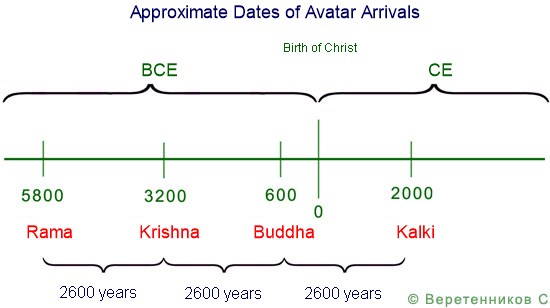
Krishna, Vishnu's eighth avatar, appeared at the end of the fourth millennium BC, approximately 3200 BC. This date agrees with the Vedas and with historians' calculations. After 2,600 years came Vishnu's ninth and penultimate avatar, Buddha, in 600 BC. We are now in the year 2000, rounding it off. It follows that approximately 2,600 years have now passed since Buddha: the same interval as that between Buddha and Krishna, 2,600 years.
Unfortunately, we do not know exactly when Rama appeared according to our calendar, as his arrival preceded those of Krishna and Buddha. However, we have a historical document, the Ramayana, describing Rama's remarkable deeds. Based on these historical events and ancient structures built during Rama's time, scientists can give approximate dates for the events and the construction of those monuments. This means that Rama's arrival also falls somewhere around those dates. Their figures place it approximately seven to ten thousand years ago.
Let us do some simple arithmetic. Add 2,600 + 2,600 + 2,600, representing the arrivals of Buddha, Krishna and Rama if we assume the Avatars came every 2,600 years. This gives 7,800, which certainly fits the description "many thousands of years ago", as well as the seven to ten thousand years stated by scientists.
False information about the duration of Kali Yuga, in which we now live, and the preceding Yugas is currently circulating in many sources. They measure them in millions of years. We need to understand that the Vedas are not speaking of our years, or even of our dimension. Each Yuga has its own dimension and its own flow of time. They explicitly say, for example, that in the Golden Age, Satya Yuga, everything was different: the Earth became multidimensional, and the people living on it existed simultaneously in many dimensions, so the Earth began to look quite different to them from how we see it now. In other words, we now see everything in four dimensions — length, height, width and time — whereas in Satya Yuga there were far more. As human beings degenerated with each Yuga, their perception of multiple dimensions became restricted. As a result, people now see only the bare minimum of what exists in Reality.
We can therefore state, on the basis of the scientific historical evidence available, that all Vishnu's avatars appear at intervals of approximately 2,600 years. In other words, we are now in the period when Vishnu's last avatar may come.
© Sergey Veretennikov
21.12.2013
« Esoteric Video Section — video materials for development and self-knowledge.
See also the "Good Music" section


